

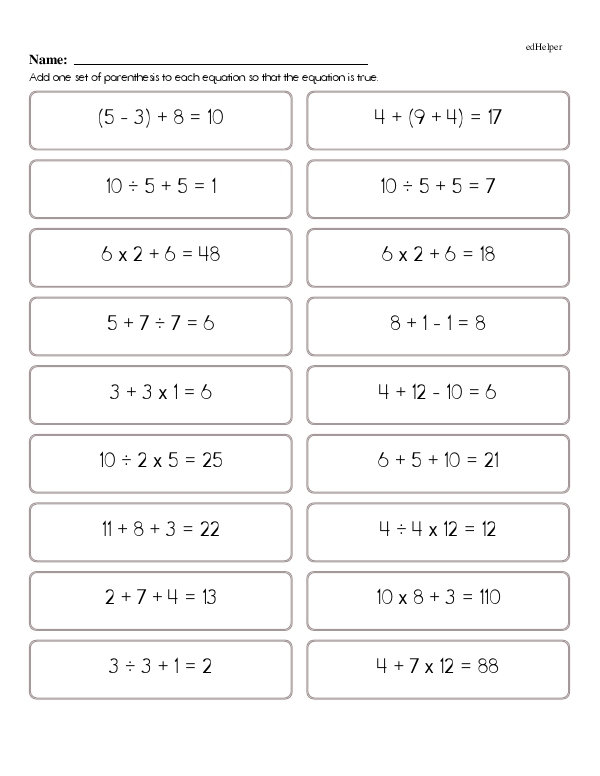
The worksheet titled "Practicing Algebraic Thinking With Numerical Equations and Expressions" features 18 small rectangles with a numerical equation in each one. Each equation has at least three numbers and two operations that can include addition, subtraction, multiplication, and division.
The directions at the top of the page instruct students to add one set of parentheses to each equation to make it true. The first two equations at the top of the page include parentheses so students can see how to do it. For example, they see the equation (4x5)+5=25. Then, they enter parentheses into the following equations, like 8+6÷2=7.
Understanding the order of operations is an important first step in algebraic logic. Once students understand which equations must be completed first, they can find the correct answer, but it also creates a foundation for them to use their problem-solving skills to solve for letters in an equation.
It is a good idea to start with simple equations. For example, students can solve the equation 10÷2+8, which gives them practice answering division problems before addition problems. You can introduce parentheses as a way for students to associate them with operations that are completed first. For example, they would insert parentheses in the above problem around the equation 10÷2, since it's the one that's answered first.
Eventually, you can give them the answer and ask them to add parentheses where they would be correct. For example, the above problem would be displayed as 10÷2+8=1. Instead of putting the parentheses around 10÷2, they would have to put them around 2+8 to get 1 as the answer.
Practicing Algebraic Thinking With Numerical Equations and Expressions
Additional Educational Resources:
Algebra Large Workbook - (Grade 5)
Algebraic Expressions Large Workbook - (Grade 6)
Quick Assessment - Beginning Algebra: Exploring Algebraic Expressions - Variables, Expressions, and Equations
Quick Assessment - Working with Small Factors: Multiplying and Dividing by 1-Digit
Practicing Algebraic Thinking With Numerical Equations and Expressions
GRADES:
Additional Educational Resources:
Algebra Large Workbook - (Grade 5)
Algebraic Expressions Large Workbook - (Grade 6)
Quick Assessment - Beginning Algebra: Exploring Algebraic Expressions - Variables, Expressions, and Equations
Quick Assessment - Working with Small Factors: Multiplying and Dividing by 1-Digit