

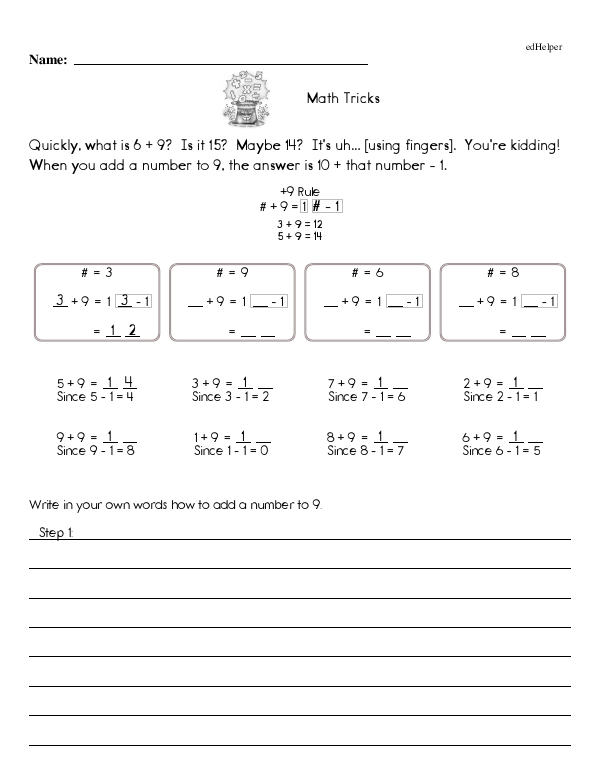
The worksheet "Practicing Math Tricks When Adding 7, 8, and 9" shows students a simple trick when adding large, single-digit numbers. The directions ask students to answer a math problem that adds 7, 8, or 9 quickly. Then, the directions state that you can make ten plus the number being added minus 1, 2, or 3, depending on whether you're adding 9, 8, or 7, respectively.
For example, on the worksheet that asks students to add problems with 7, they are instructed to subtract 3. For example, the problem 4 + 7 would be 10 plus 4 - 3 for a total of 11.
Each worksheet shows the rule clearly at the top of the page with examples. The next section has students fill in the numbers in the blanks in the scaffolded rule that is displayed above. Then, they fill in the ones digit on eight problems that follow the rule. They write in their own words how to add according to each rule at the bottom of the page.
There are many tricks that students can learn when practicing mental math skills. It can be helpful to have students practice some of these tricks so they can learn which ones work for them.
For example, adding large single-digit numbers like 7, 8, and 9 can be done by creating 10 and then subtracting 1, 2, or 3. You can teach students this trick, and they can use it to find the answers to math problems quickly. For example, they can complete a problem like 6 + 7 mentally by solving 6 - 3 and then adding 10 to get 13.
Students can practice using doubles and adding or subtracting to get the answer. For example, students could solve a problem like 8 + 7 by adding 7 + 7 and adding one more, or by adding 8 + 8 and subtracting one.
You can introduce these tricks and have students practice them, or you can encourage them to discover addition tricks on their own and share them with their classmates.
Practicing Math Tricks When Adding 7, 8, and 9
Practicing Math Tricks When Adding 7, 8, and 9
GRADES:
Additional Educational Resources:
Mental Math and Estimation Large Workbook - (Grade 3)
Addition Up to 10,000 Large Workbook - (Grade 3)
Quick Assessment - Fun Mental-Math Workbook in Easy Addition