

"Practicing One-Digit Multiplication Facts: Filling in Factors and Products" is a worksheet that helps students practice multiplication facts by displaying multiplication problems in different ways.
The top of every page displays horizontal, single-digit multiplication problems in small, dashed boxes. The first problem displays all the digits of each number, including the answer. The following three problems ask students to fill in both factors and answers.
The other problems on the page display horizontal multiplication facts, and students fill in the answer. Multiplication problems that are exactly the same are located in dashed boxes. Multiplication problems are printed in different sizes to make them visually different.
Lower-grade-level pages focus on problems with one factor that remains the same, like problems that all include the number 3. Upper-grade-level pages have students practice three numbers, like problems that include 2, 5, and 9. Other pages mix up the facts, asking students to practice problems that can contain any digit from 1 to 9.
Once students have learned the mechanism behind multiplication, they should work towards memorizing multiplication facts. This helps them find the answer to problems more quickly, and it boosts confidence. It can also help them tackle more complex problems in the future because they aren't stuck solving basic multiplication facts before solving the rest of the problem.
The trouble is, traditional multiplication practice can be boring for students. One of the simplest ways to make multiplication facts more engaging is to create worksheets with multiplication problems that look visually different. Display multiplication problems horizontally and vertically, or use a larger print size and different fonts on some problems compared to others.
Another way to make worksheets more interesting is to ask students to identify individual factors in multiplication problems instead of finding the answer. You can also make worksheets tricky by repeating the same digits, but also include a few problems with different digits. This prevents students from filling in the same numbers without looking at and thinking through the problems.
Practicing One-Digit Multiplication Facts: Filling in Factors and Products
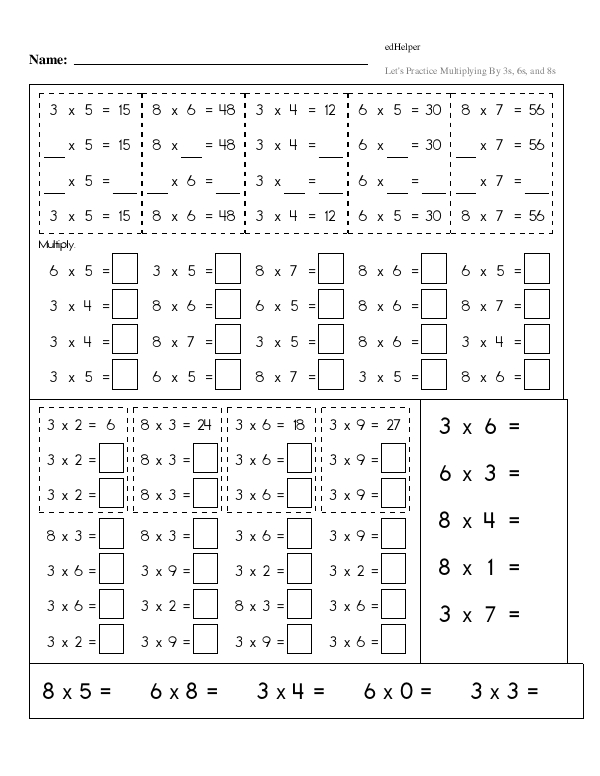
Practicing One-Digit Multiplication Facts: Filling in Factors and Products
GRADES:


Additional Educational Resources:
Estimation and Number Theory Large Workbook - (Grade 4)
Multiplication (with one factor being larger than one digit) Large Workbook - (Grade 3)
Quick Assessment - Whole-Number Workout: Ordering, Comparing, and Place Value of Large Values