

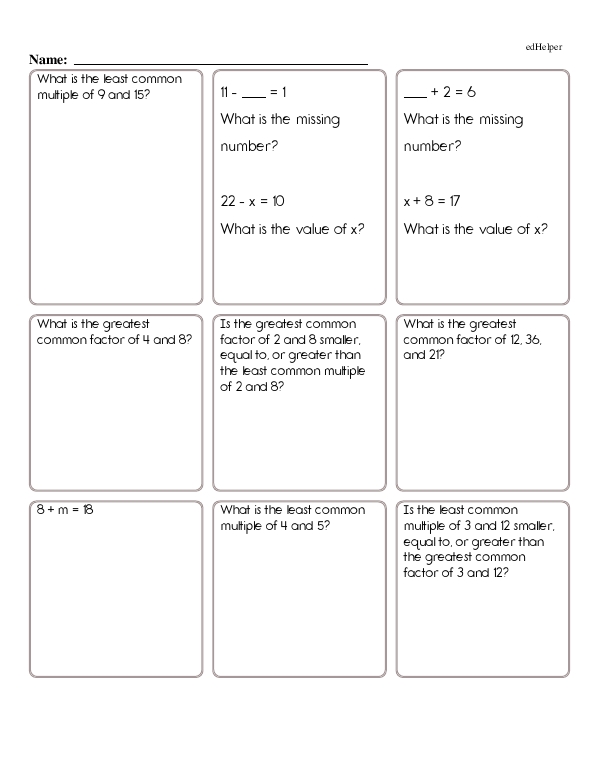
The worksheet titled "Practicing One-Variable Equations, Plus Questions About Factors and Multiples" features one-variable equations. In some cases, students are asked to find the missing number or letter, while in other cases, the equation is simply shown with a letter instead of a number.
The worksheet also features factors and multiples practice. Some questions ask students to find the greatest common factor, some ask for all the factors in a given number, and some ask for the least common multiple. Some questions are even more complex. For example, one asks, "Is the least common multiple of 4 and 2 smaller than, equal to, or greater than the greatest common factor of 4 and 2?"
There are a few questions that pertain to angles and lines, primarily asking students to identify them. For example, students might be asked to sketch an obtuse angle or draw intersecting lines.
Worksheets contain three or four rows of problems contained within their own boxes, so students have space to work out each answer.
Students learn algebraic concepts more thoroughly when you can pose problems in a variety of ways. For example, instead of simply stating "m + 5 = 18" and assuming students will find the value for "m," leave one number blank and ask students to find the missing number. You can also ask them to find the value of the letter explicitly. This approach also lays the foundation for solving multivariable equations in the future.
It is also helpful for students to learn related skills, like factors and multiples. When they get comfortable finding things like the least common multiple or the greatest common factor for whole numbers, they will be able to more confidently tackle adding or subtracting algebraic fractions or factoring algebraic equations in more advanced math classes.
Practicing One-Variable Equations, Plus Questions About Factors and Multiples
Practicing One-Variable Equations, Plus Questions About Factors and Multiples
GRADES:

Additional Educational Resources:
Equations and Inequalities Large Workbook - (Grade 6)
Whole Numbers Large Workbook - (Grade 5)
Quick Assessment - Building Blocks of Numbers: Exploring Whole Numbers
Quick Assessment - Solving Simple Inequalities: Exploring One- and Two-Step Inequalities