

Students get a skip counting challenge on these worksheets. Instead of skip counting by smaller numbers, like two and five, they have to skip count by six and nine!
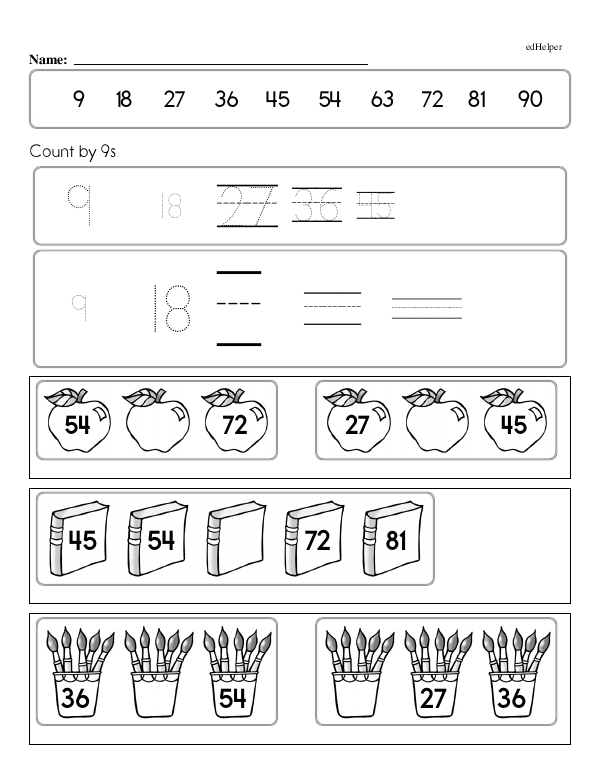
Each page features a list of numbers at the top that skip count according to the directions on the worksheet. For example, if students will be skip counting by six, the numbers 9, 18, 27, 36, 45, 54, 63, 72, 81, and 90 will be listed at the top.
Students trace and write the numbers in the pattern next. They trace the numbers in the first activity. Then they trace the first few numbers and write the remaining numbers on the lines in the next activity.
The last activity features pictures in a series. Some of the images are labeled with numbers, but one image is blank. Students have to fill in the missing number. For example, if they're counting by nine, they would fill the blank dog bone with the number 54 when the next two dog bones are labeled 63 and 72.
Skip counting provides students with a counting challenge, in addition to giving them exposure to multiplication facts. That's especially true if you ask students to skip count by challenging numbers.
For example, students could write a series of numbers skip counting by six. They could then label how many sixes are in each number, like two sixes in the number 12 and three sixes in the number 18.
You can also ask students to look for patterns in a series of numbers, like when skip counting by nine. Students can see that the ones digit decreases by one in each number, which can come in handy when they learn how to multiply nines in the future.
Skip Counting Challenge: Counting by Six and Nine
Skip Counting Challenge: Counting by Six and Nine
GRADES:
Additional Educational Resources:
Multiplication Tables Large Workbook - (Grade 2)
Multiplication and Mental Math Large Workbook - (Grade 2)
Quick Assessment - Mastering 8 and 9 Multiplication