

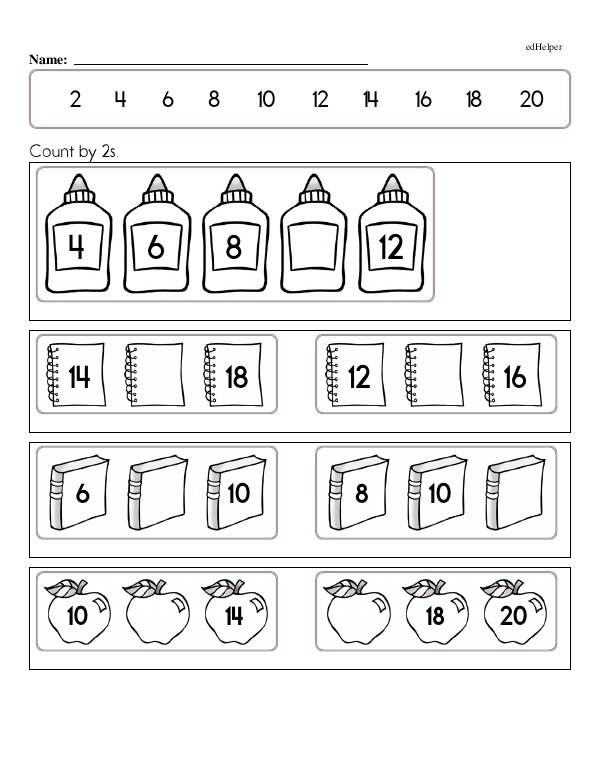
Give your students a skip counting challenge with these worksheets! Each page features sections with a series of three to five images. All but one of the images in each series has a number. Students have to follow the directions to fill in the missing number. For example, the directions might tell students to "Count by 4s." A series of frogs are labeled 12, ___, 20. Students write the number 16 in the empty frog.
Each page features six or seven sets of images that include animals, like butterflies and turtles, as well as objects, like clovers and sailboats. Pages also include a number line that follows the same rule. So, on a page that asks students to "Count by 5s," the number line shows 5, 10, 15, 20, 25, 30, 35, 40, 45, 50 so students can reference the skip counting pattern as they work.
Skip counting supports pattern development and multiplication skills, especially if you challenge students to skip count by many different numbers.
Students should start with small numbers first, like two and three. As they get better at skip counting, you can challenge them to count by more difficult numbers, like seven or nine.
See if students can find patterns in the numbers they're skip counting by. For example, when skip counting by fives, the ones digit is always a five or a zero. This helps them develop their critical thinking skills, and it can make learning multiplication facts easier in the future.
Skip Counting Up to Nine
Additional Educational Resources:
Numbers to 100 Large Workbook - (Grade 1)
Multiplication and Mental Math Large Workbook - (Grade 2)
Quick Assessment - Multiply 6 and 7
Skip Counting Up to Nine
GRADES:

Additional Educational Resources:
Numbers to 100 Large Workbook - (Grade 1)
Multiplication and Mental Math Large Workbook - (Grade 2)
Quick Assessment - Multiply 6 and 7