

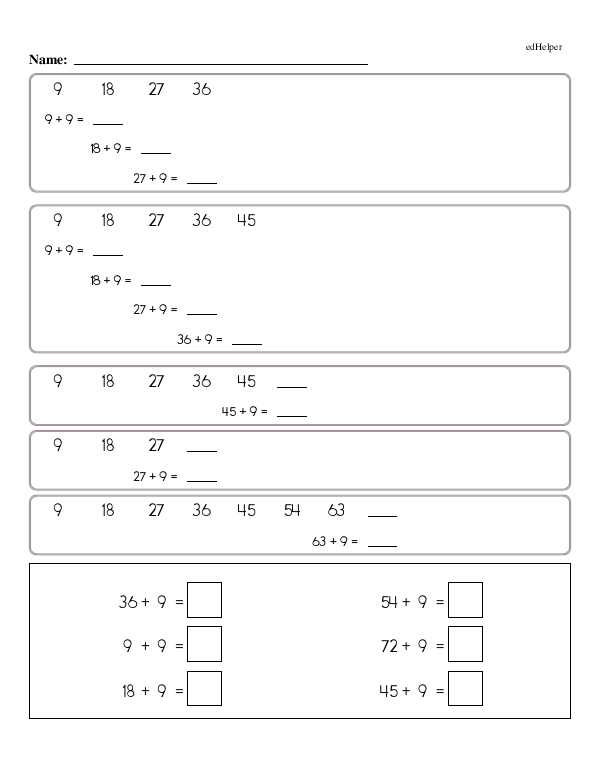
Students can see how counting on and skip counting relate to addition on these worksheet pages! All sections on each page focus on the same pattern, but they feature slightly different activities that include:
* Solving addition problems that match the numbers listed above, like 7 + 7 = ___, 14 + 7 = ___, and 21 + 7 = ____ for the numbers 7, 14, 21, and 28
* Finding the next number in a series by solving an addition problem, like 28 + 7 to figure out what comes next in the series 7, 14, 21, 28, ___.
* Solving addition problems that follow the same pattern, like 42 + 7 = ___ and 17 + 7 = ___.
Each activity is enclosed in a rectangle to separate it from the other activities on the page. Skip counting numbers include six, seven, eight, and nine to give students a challenge.
Skip counting and counting on form the basis for multiplication, which can give young students an introduction to multiplication principles.
For example, students can add 7 + 7, 14 + 7, and 21 + 7 to see what answers they get from adding 7 over and over again. They can fill these numbers into a number line or use them to figure out what comes next in a series of numbers.
This type of addition can also help students discover patterns that make addition and multiplication easier. For example, students can see that the ones digit in addition problems that add nine is one less while the tens place is one more. They can predict what the next number in the line would be without doing any addition or multiplication problems.
Skip Counting and Addition Practice
Additional Educational Resources:
Making Groups (Multiplication and Division Ideas) Large Workbook - (Grade 1)
Addition and Subtraction to 100 Large Workbook - (Grade 1)
Skip Counting and Addition Practice
GRADES:

Additional Educational Resources:
Making Groups (Multiplication and Division Ideas) Large Workbook - (Grade 1)
Addition and Subtraction to 100 Large Workbook - (Grade 1)