

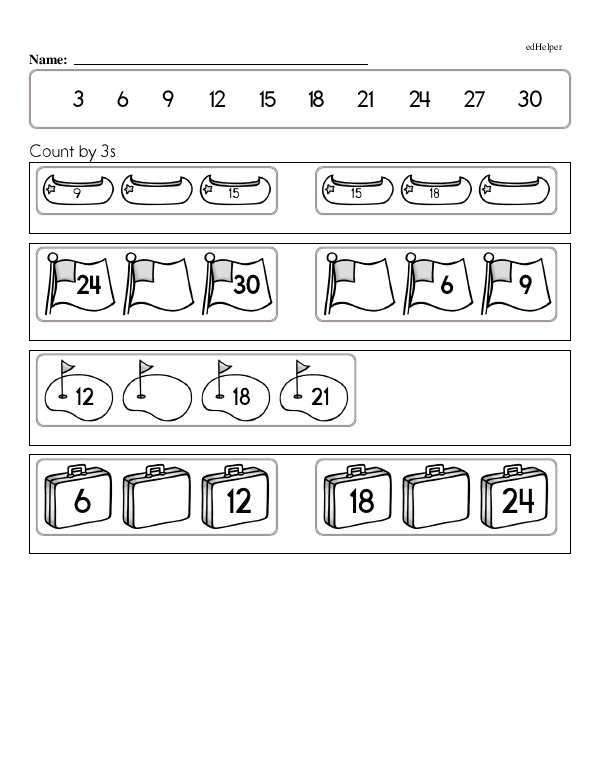
"Skip Counting and Filling in the Missing Number in a Sequence: Fall Theme" is a worksheet that encourages students to think about counting by 5s or 3s.
Each worksheet page starts by listing the numbers that are being skip counted. Pages where students skip count by 5s list 5, 10, 15, 20, 25, 30, 35, 40, 45, 50. Pages where students skip count by 3s list 3, 6, 9, 12, 15, 18, 21, 24, 27, 30.
Then, the worksheet shows a series of pictures. Each series contains three, four, or five fall-friendly images, like leaves or turkeys. Each image contains a number, but one is left blank. Students have to fill in the number according to the pattern they're counting by. For example, a series of acorns might show 15, 18, a blank, and 24. Students fill in the missing number 21.
Learning to skip count helps students learn how to count larger numbers more quickly. It also helps create the basis for multiplication later.
When students first start learning to skip count, it can be helpful to give them the series of numbers they will be working with. For example, if they are counting by twos, show them the sequence of numbers 2, 4, 6, 8, 10. You can even ask them to fill in the missing numbers to show them that the digits are part of the number line, even if some numbers are skipped. For example, if the number line counts by twos, students could fill in every other number, like 1 before 2 and 3 ahead of 4.
Have them write a series of numbers starting with different digits. For example, instead of writing 2, 4, 6, ask students to start with the number 12 and count by twos. You can also give them a series of numbers with some blanks that they have to fill in, like filling in the number 4 in the series 2, a blank, 6, 8.
Skip Counting and Filling in the Missing Number in a Sequence: Fall Theme
Additional Educational Resources:
Numbers to 100 Large Workbook - (Grade 1)
Making Groups (Multiplication and Division Ideas) Large Workbook - (Grade 1)
Skip Counting and Filling in the Missing Number in a Sequence: Fall Theme
GRADES:

Additional Educational Resources:
Numbers to 100 Large Workbook - (Grade 1)
Making Groups (Multiplication and Division Ideas) Large Workbook - (Grade 1)