

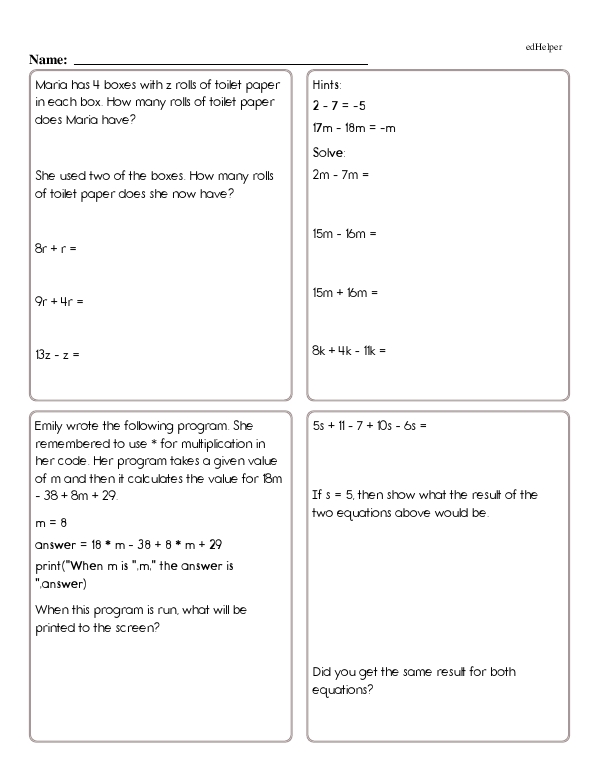
"Solving and Simplifying Algebraic Expressions With Word Problems" is a worksheet that asks students to solve and simplify algebraic equations.
Equations that need to be simplified may have multiple numbers and operations, but each has only one letter, even if it repeats. For example, students are asked to simplify "19y - 7y + 16." Some questions give students the value of the letter and ask them to solve both the first expression and the simplified expression to see if they get the same answer.
Other questions include word problems. For example, one asks students to find how many rolls of toilet paper a person has if they know the number of boxes, but the number of rolls is represented by a letter. Other word problems incorporate the concept of coding a program or counting pencils when a letter represents the number of pencils in each box.
The problems are organized in rectangles, with similar problems grouped together within each rectangle. For example, students might simplify different expressions in the same box or work through a step-by-step word problem in another.
Learning how to simplify algebraic expressions helps students make complex problems simpler. It also encourages logical thinking and tackling problems step-by-step.
Start with expressions that contain the same letter but include multiple instances of that letter with different numbers and operations. Keep addition, subtraction, multiplication, and division together so students can learn to simplify without worrying about the order of operations. For example, they might simplify 21s - 8s + 22s + 5s.
Word problems can help students think through real-world situations where simplifying an expression might be necessary. Word problems can include pretend coding programs where students find the answer to an equation when different letters are represented by different numbers. Once they become familiar with the format, they can develop their own coding program and exchange it with another student.
Solving and Simplifying Algebraic Expressions With Word Problems
Solving and Simplifying Algebraic Expressions With Word Problems
GRADES:
Additional Educational Resources:
Algebraic Expressions Large Workbook - (Grade 6)
Equations and Inequalities Large Workbook - (Grade 6)
Quick Assessment - Solving Simple Inequalities: Exploring One- and Two-Step Inequalities