

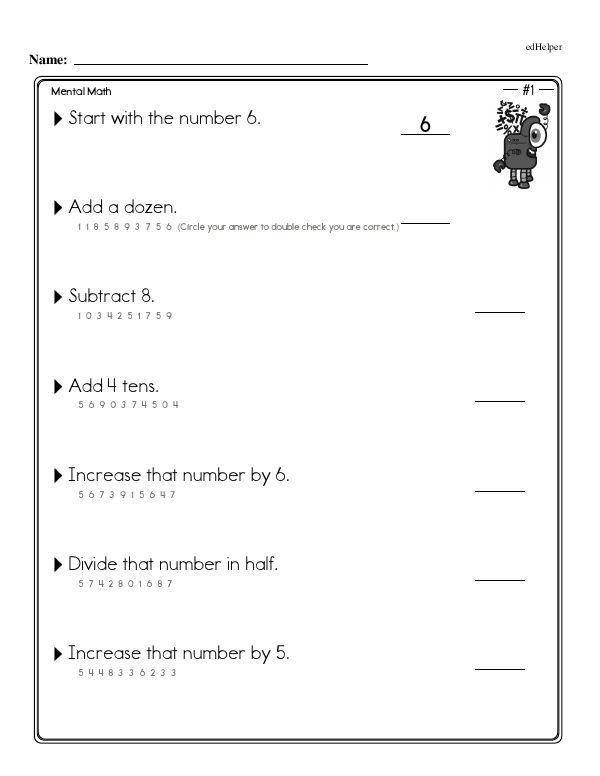
The worksheet titled "Step-By-Step Mental Math Practice" asks students to find the answer to word problems one step at a time in order to find the final answer. The first step is always accompanied by the answer. For example, the number 11 is provided on the line for the word problem that says, "Start with the sum of 5 and 6."
There are between 7 and 11 directions on each page that ask students to do things like:
* Add the number of legs on an animal, like a pig
* Increase the number by another number
* Round the number to the nearest 10
* Subtract a group of tens
* Multiply by a given number
* Add the number of pennies in a dollar
* And more
Directions are chosen to ensure they are grade-level appropriate. Lower grade levels feature 7-step problems, with upper grade levels featuring as many as 11 steps. Each step features a series of numbers listed underneath. The answer to that step is hidden in the digits. Students circle the answer they get before writing it on the line to double-check that they are correct.
Encouraging students to do mental math is important because it helps them practice math fluency, increases confidence, and makes finding the answer to math problems much easier, especially as they learn higher-level math concepts.
You can encourage students to develop mental math skills by reading aloud a problem and asking students to write down the answer without showing their work. Worksheets can be used too, as long as students know they must complete problems mentally.
You can check fluency by giving them step-by-step mental math worksheets where the answer from the previous problem is used to solve the next one. It encourages students to think through problems one at a time. When they write the answer to each step down, you can see where they might have made a mistake.
Step-By-Step Mental Math Practice
Additional Educational Resources:
Mental Math and Estimation Large Workbook - (Grade 3)
Multiplication and Mental Math Large Workbook - (Grade 2)
Quick Assessment - Working with Small Factors: Multiplying and Dividing by 1-Digit
Quick Assessment - Whole-Number Workout: Ordering, Comparing, and Place Value of Large Values
Step-By-Step Mental Math Practice
GRADES:


Additional Educational Resources:
Mental Math and Estimation Large Workbook - (Grade 3)
Multiplication and Mental Math Large Workbook - (Grade 2)
Quick Assessment - Working with Small Factors: Multiplying and Dividing by 1-Digit
Quick Assessment - Whole-Number Workout: Ordering, Comparing, and Place Value of Large Values