

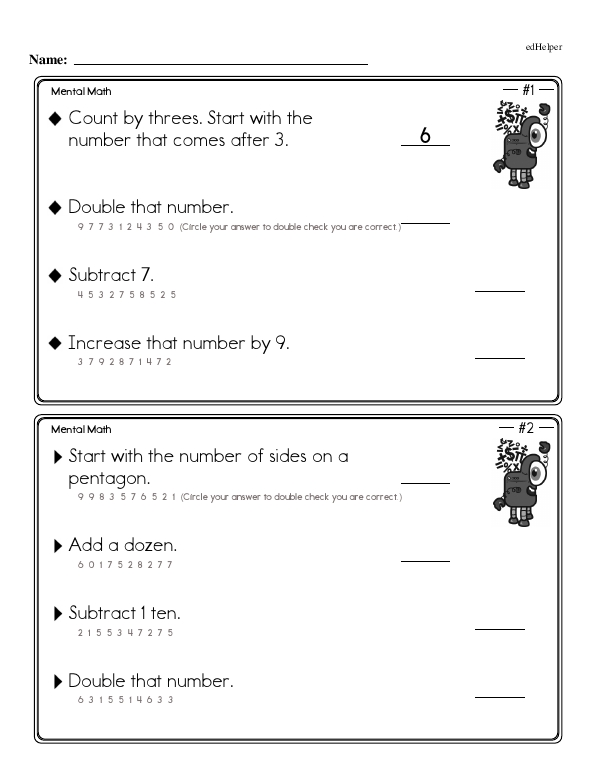
The worksheet titled "Step-By-Step Mental Math Word Problems" features multi-step word problems that have been broken down into individual steps. Students read each problem and use mental math to find the answer before moving on to the next step in the problem. For example, the worksheet might begin with, "Start with the number 6." Then, students "add 4 tens" before being asked to "divide that number in half."
The number of steps and the type of mental math problems increase in difficulty as the grade level increases, with opportunities for students to practice:
* Addition, subtraction, multiplication, and division
* Place value
* Math terminology, like the sum and difference
* Measurement, like the number of cups in multiple quarts
Each question also contains a string of digits underneath where students can find their answer. If they can't find their answer, they have to go back and try again. There is a blank next to each problem where they can write the answer for each step. Each set of questions is in a rectangle, so students see each set of problems clearly.
Mental math is an important skill for students to learn. It helps them develop confidence and mastery of basic mathematical operations that make tackling more difficult math concepts easier as they get older.
Encouraging mental math can be difficult because students are often tempted to work out individual problems on paper. You can encourage them to do the math in their head by giving them multi-step problems. Having multiple problems to solve, especially if you also require them to find the answer in a certain time frame, encourages them to find the answers mentally.
You can scaffold longer problems by breaking them down into steps so students can practice finding the answer before moving on to the next problem. It can be especially helpful to allow students to double-check their answer before moving on to the next step, especially if they are new to doing mental math.
Step-By-Step Mental Math Word Problems
Step-By-Step Mental Math Word Problems
GRADES:
Additional Educational Resources:
Place Value of Whole Numbers Large Workbook - (Grade 4)
Multiplication and Mental Math Large Workbook - (Grade 2)
Quick Assessment - From Fractions to Decimals (and Back) and their Place Value
Quick Assessment - PEMDAS Power: Mastering the Order of Operations