

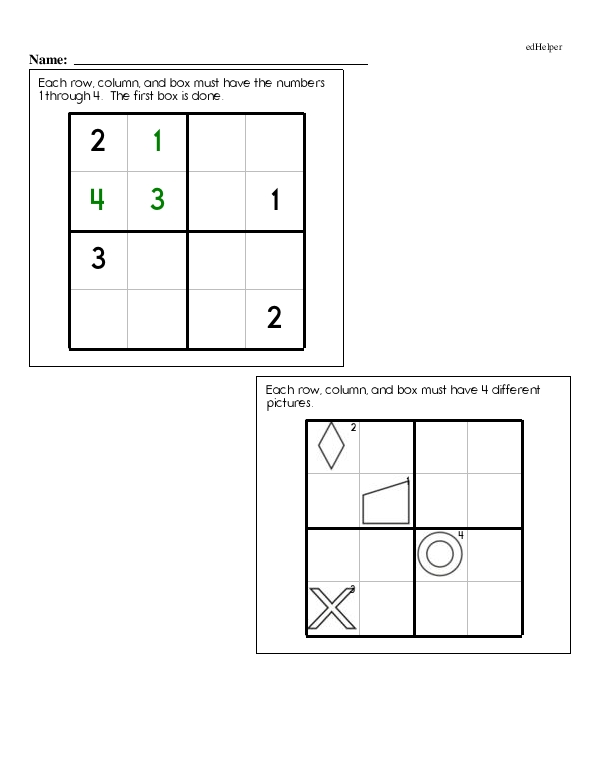
The worksheet titled "Sudoku Puzzles With Numbers, Pictures, and Words" features a variety of creative Sudoku puzzles that are designed to encourage problem-solving, but they also support addition and spelling skills.
For example, some Sudoku puzzles feature two adjoining boxes with dashed lines. The two numbers in those boxes should equal a certain number, which reinforces math facts and enables students to double-check their answers as they work. Sudoku number puzzles in lower grades have boxes that contain the numbers 1-6, while some upper-grade worksheets feature traditional Sudoku with 1-9 in each box.
Sudoku puzzles on the worksheet also include Word Sudoku, where every word in the word list must be located once in every row, column, and box, giving students plenty of spelling practice. Other puzzles feature pictures, so students have to make sure each shape is located in every row, column, and box.
Sudoku is a great way for students to practice their problem-solving skills, but it can also support addition facts, spelling, and even math concepts.
When practicing Sudoku and addition, find Sudoku Sums worksheets where some squares are outlined with dotted lines. These two numbers throughout the puzzle have the same answer, making it a great way for students to practice fact families.
Sudoku can be a fun spelling activity. Instead of filling numbers into empty boxes, students must fill their spelling words into each box so every word occurs just once in every row, column, and square.
Sudoku can also help students learn or review shapes in a geometry unit. Each row, column, and square must contain the same shape. Students could even create a key and write the name of each shape down below.
Sudoku Puzzles With Numbers, Pictures, and Words
Sudoku Puzzles With Numbers, Pictures, and Words
GRADES:






Additional Educational Resources:
Shapes and Patterns Large Workbook - (Grade 2)
Two-Dimensional Shapes Large Workbook - (Grade 3)
Quick Assessment - Geometry Challenge - Shapes, Flips, and Turns
Quick Assessment - Easy Lightning-Fast Subtraction Problems