

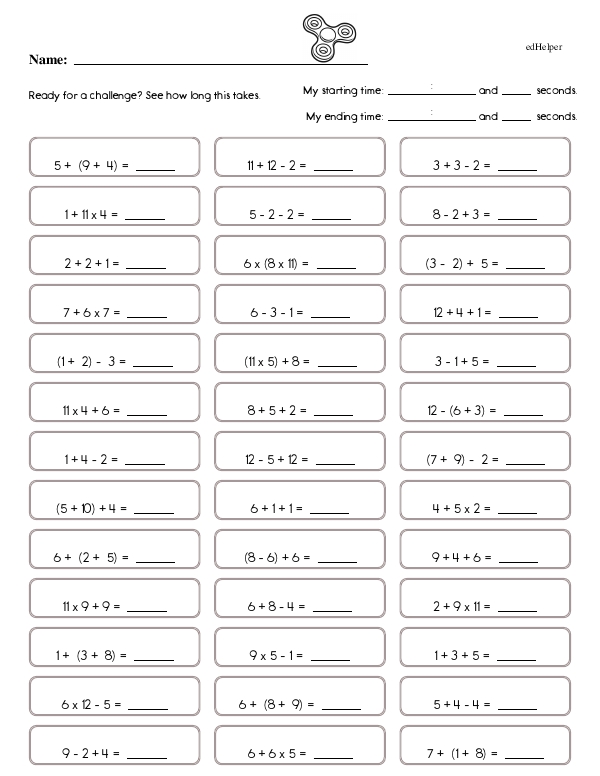
"Timed Order of Operations With Three and Four Numbers" is a timed worksheet with 39 problems that require students to use their knowledge of the order of operations to solve them. Each problem contains three or four numbers, and they can contain all four operations, in addition to parentheses. Most numbers are below 20, but there are higher numbers when they involve specific facts, like 100 ÷ 10 or 64 ÷ 8.
A few examples include:
* 9 - 4 + 9 + 2 =
* 6 x 8 - 10 =
* 10 + (11 - 2) =
* 10 + 44 ÷ 4 =
The top of the page includes blanks where students can write their starting time and ending time, encouraging them to use mental math to complete the worksheet quickly.
Learning the order of operations is an essential skill that enables students to tackle advanced math in the future, including algebra and calculus.
If you want to focus on the operations themselves, ask students to complete problems with numbers that are easy for them to answer mentally. Use numbers up to 20, and when using higher numbers, make sure they are paired with other numbers that represent a math fact that students already know. For example, students can complete an order of operations problem like "1 + 9 x 5 =" in their head. They should also be able to complete a problem like "5 x 100 ÷ 10 =" mentally.
Let them look at a cheat sheet that outlines the order of operations when they first get started. As they become more proficient, you can take the cheat sheet away and ask students to rely on their knowledge of the order of operations. You can also ask them to time how long it takes to complete a worksheet. It can be a fun challenge for students to beat their previous time, but it can also be used as an informal assessment to see which students need more instruction.
Timed Order of Operations With Three and Four Numbers
Timed Order of Operations With Three and Four Numbers
GRADES:
Additional Educational Resources:
Estimation and Number Theory Large Workbook - (Grade 4)
Whole Number Multiplication and Division Large Workbook - (Grade 4)
Quick Assessment - Number Sense: Estimation, Factors & Multiples