

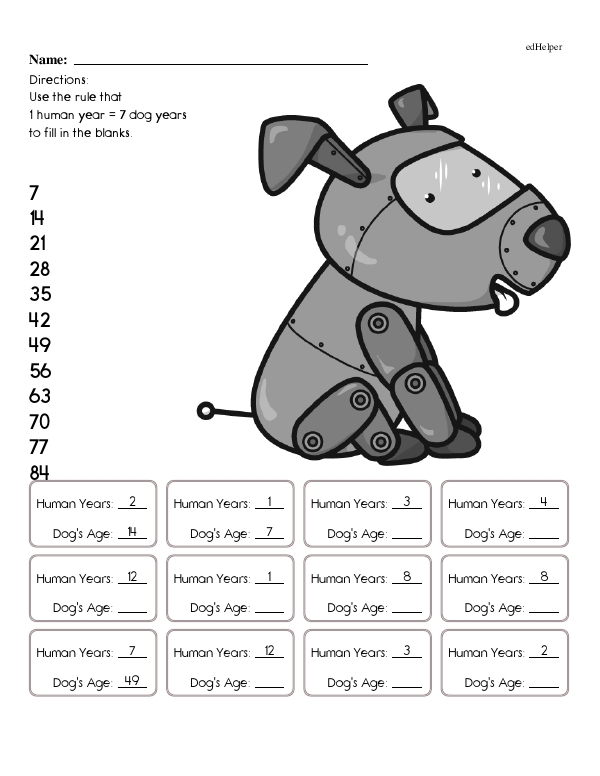
The worksheet titled "Unit Rates: Using Human Years to Find a Dog's Age" is a fun way for students to practice unit rates and multiplication.
Each page starts with directions that state, "Use the rule that 1 human year = 7 dog years to fill in the blanks." At the bottom of the page, there are 12 boxes with blanks that are labeled "Human Years" and "Dog Years." All the human years are filled in. In some cases, the dog's age is filled in, but in other cases, it's blank, which means students have to fill in the answer.
This worksheet is perfect for young students because the multiples of 7 are listed on the page. The multiples are listed without the multiplier, encouraging students to count and figure out the multiples of each. For example, students would count out four numbers on the list (7, 14, 21, 28) to find out how old a dog is if its human age is 4.
Activities that integrate unit rates can help students build the concept of multiplication as repeated groups. It also supports pattern recognition, and it can help form the foundation for ratios later on.
Comparing human years to dog years is a fun activity for young students who are just beginning to explore multiplication concepts. They can find out how old a dog is in dog years if they know a dog ages 7 years for every 1 human year.
You can invite students to explore other unit rates, and these can even tie into other subjects. For example, if every fish has 1 tail and 2 fins, students can find out how many fins and tails are in an aquarium. In music, students could count how many claps there are in a song if they clap every 2 beats.
Unit Rates: Using Human Years to Find a Dog's Age
Additional Educational Resources:
Numbers to 100 Large Workbook - (Grade 1)
Making Groups (Multiplication and Division Ideas) Large Workbook - (Grade 1)
Unit Rates: Using Human Years to Find a Dog's Age
GRADES:

Additional Educational Resources:
Numbers to 100 Large Workbook - (Grade 1)
Making Groups (Multiplication and Division Ideas) Large Workbook - (Grade 1)