

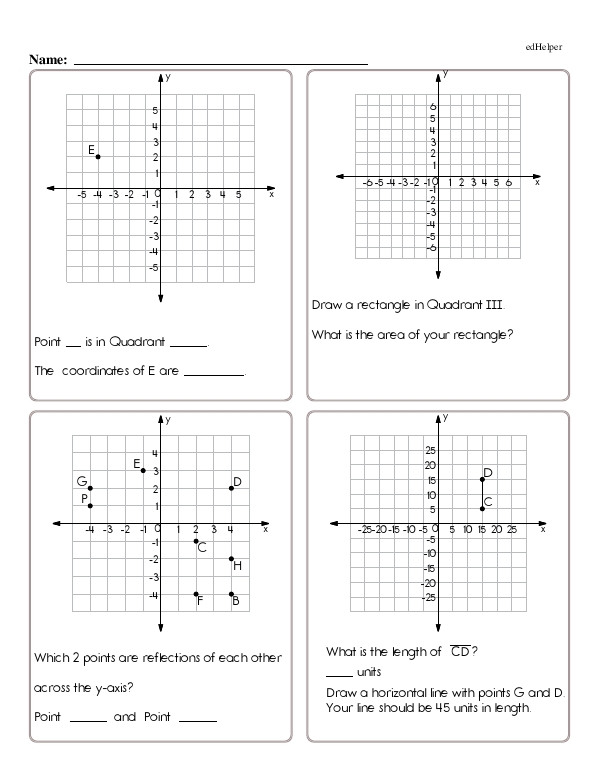
The worksheet "Using Coordinate Planes to Find Quadrants, Coordinates, Lengths, and More" features three or four different coordinate planes on each page. Each coordinate plane is located within its own section and contains its own set of questions. Some of the questions include:
* Which quadrant a given point is located in.
* Whether a point is located on the X or Y axis.
* Which two points are reflections of each other?
* The length of a line between two points.
* The coordinates of points on a coordinate plane.
* Filling in the blanks with math vocabulary words like "point" and "coordinate."
On pages with only three coordinate planes, the fourth section contains a data word problem. Students might be asked to plot a secret point on a coordinate plane or visualize what the second set of coordinates is in a reflection.
Learning how to read coordinate planes builds spatial and logical thinking skills, in addition to building connections between real-world concepts like maps, blueprints, and even video games with characters who are tracked and displayed on a map.
Skills should go beyond asking students to plot a point on a coordinate graph. They should also be able to identify the quadrant that a point is located in, the distance between two points, and what two points on a coordinate plane are reflections of each other.
Graphing supports a lot of fun activities that students can do with each other during class. For example, one student can come up with a secret set of coordinates and give clues to another student who has to map it. You can create maps and measure points between real-life objects, like equipment on the playground outside, and students can even play Battleship to practice.
Using Coordinate Planes to Find Quadrants, Coordinates, Lengths, and More
Using Coordinate Planes to Find Quadrants, Coordinates, Lengths, and More
GRADES:
Additional Educational Resources:
Number Lines and Negative Numbers Large Workbook - (Grade 6)
The Coordinate Plane Large Workbook - (Grade 6)
Quick Assessment - Exploring Positive and Negative Values: Comparing, Ordering, and Evaluating Integers