

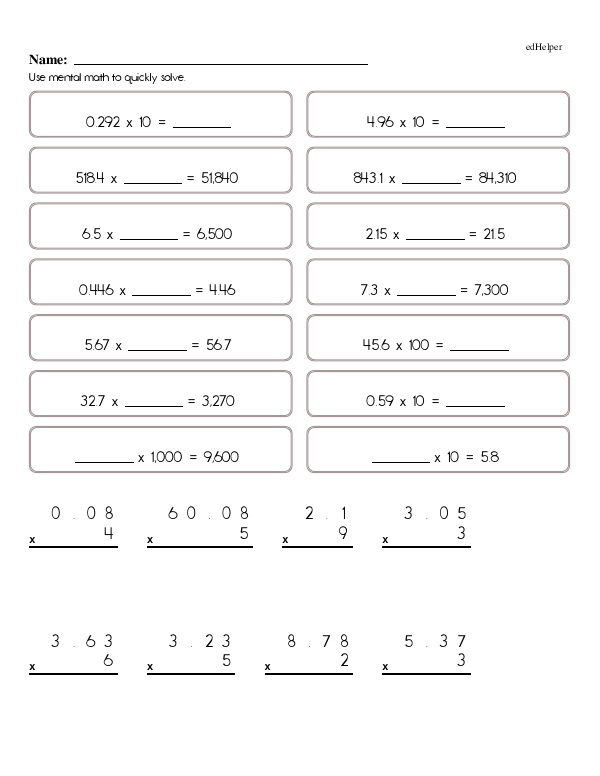
The worksheet titled "Using Mental Math to Multiply Decimals and Powers of Ten" starts by asking students to solve multiplication problems using mental math. Each one contains a decimal and a power of ten. In some cases, students write the answer. In others, they must write the power of ten in the blank, like 9.1 x ___ = 9,100. Powers of ten are kept small, like 10 and 100, so students can grasp the concept more easily. Problems are displayed horizontally to encourage students to solve each one mentally.
General multiplication practice is included at the bottom of the page. Each problem contains one decimal and one whole-digit number. Decimal numbers range from having two digits, like 9.1, to four digits, like 70.03. These problems are aligned vertically so students can work through the equation and carry numbers to find the answer.
It's important for students to learn the powers of 10 and how they affect numbers. Not only are they the basis of our number system, but they can also make mental problem solving easier.
For example, you can show students how 5.25 turns into 52.5 when it is multiplied by 10, 525 when it is multiplied by 100, and 5,250 when it is multiplied by 1,000. This skill can help them multiply decimals faster, but it can also help them when working with the metric system. They can see how to move the decimal to find a bigger or smaller measurement.
It's a good idea to pair multiplying powers of 10 with regular decimal multiplication practice, like 4.09 x 6. Students can compare and contrast their answers and discuss why finding the answer to one is easier or harder than finding the answer to another. This type of comparison encourages students to learn from each other and make discoveries that can lead to greater understanding.
Using Mental Math to Multiply Decimals and Powers of Ten
Using Mental Math to Multiply Decimals and Powers of Ten
GRADES:

Additional Educational Resources:
Decimals Large Workbook - (Grade 5)
Whole and Prime Numbers Large Workbook - (Grade 6)
Quick Assessment - Whole-Number Workout: Ordering, Comparing, and Place Value of Large Values
Quick Assessment - Decimals and Fractions: The Fraction-Decimal Connection