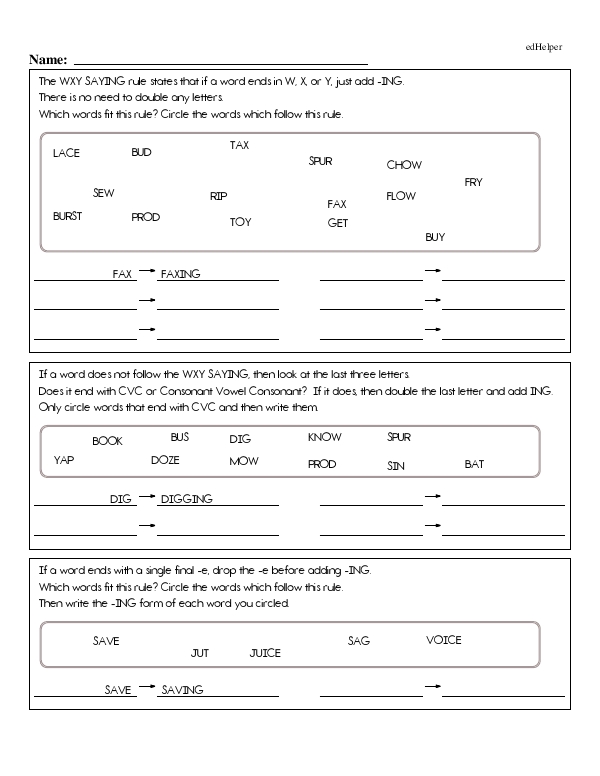
This worksheet provides a structured way for students to learn about the WXY Saying and how to use it to spell words that end in -ING.
Each page features three sections with their own set of instructions. They outline what to do when a word ends in W, X, Y, what to do when a word ends in CVC, and what to do when a word ends with -e.
A word bank is included after the directions with words that do and don't follow the above rule. Students have to circle the words according to the instructions and then write the correct -ING version. For example, when following the WXY Saying, students would circle the word "Gnaw," write it on the line, and then write "Gnawing" on the next line. In CVC sections, they would circle and write a word like "Net" before writing "Netting" on the line. In -e sections, students might circle and write "Face" before writing "Facing" on the line.
Writing different forms of the same word can be tricky because not all words follow the same rules. It can be helpful to provide students with explicit rules for different kinds of words that they can turn to when spelling.
For example, students might practice adding -ING to words that end in W, X, or Y. They should also practice adding double letters before -ING for words that end in CVC and how to drop the -e before adding -ING.
You can combine strategies and ask students to compare them. For example, does the WXY Saying work for words that end in -ed? What about plurals or adding -ly? This encourages students to think critically about the rules of spelling while giving them the tools to spell different forms of words confidently.
Using the WXY Saying, CVC, and Ending in -e Rules to Add -ING
Using the WXY Saying, CVC, and Ending in -e Rules to Add -ING
GRADES: