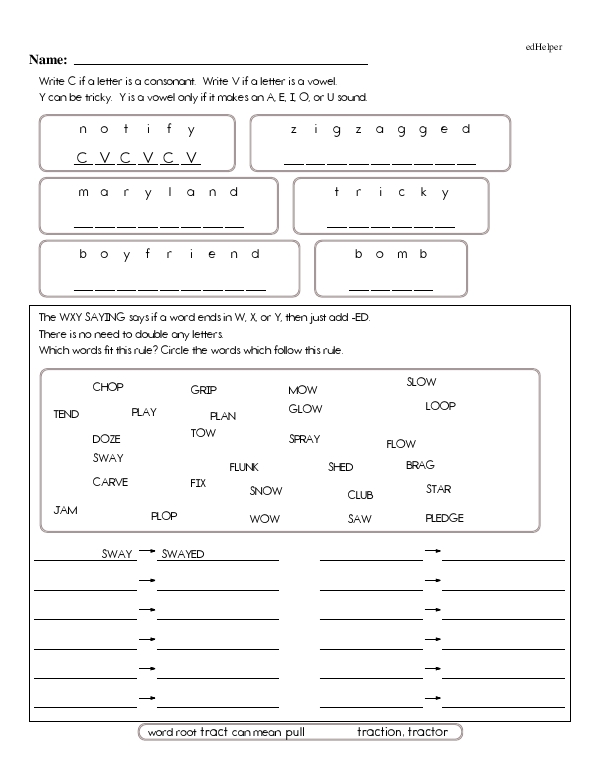
"Using the WXY Saying to Add -ED at the End of Words" is a worksheet that gives students practice using the WXY Saying to help them learn how to spell words that end in ED.
First, worksheets provide students with practice identifying consonants and vowels. They write C or V below each letter in a word, being careful to label Y appropriately, depending on the sound it makes.
Then, the worksheet reminds students that you can add ED to words that end in W, X, or Y. They circle the words in a rectangle that follow this rule before writing them down below. Then, they write the word with ED. For example, they would circle and write the word "stew" on the first blank. Then, they would write "stewed" on the second blank. One set of blanks is completed in each section of the worksheet as an example.
Other activities focus on the consonant-vowel-consonant (CVC) pattern. They ask students to circle words with this pattern at the end of the word. Then, they are asked to double the last letter before adding ED. For example, they would turn "shop" into "shopped."
Longer, more difficult words are included on higher grade levels to ensure the activity matches student learning levels.
Students can build a greater understanding of language by learning different suffixes and their meanings, like adding ED when changing a word to the past tense. Students can get practice by learning simple rules, like the WXY Saying.
For example, students can choose the words in a list that end in W, X, and Y. Then, they can write the word with an ED ending.
Students can learn the consonant-vowel-consonant (CVC) pattern as a way to help them remember to add a double last letter before adding ED. These skills can be combined for a greater challenge. Review worksheets could include multiple suffixes, like ING and ED, to help students compare and contrast how the rules work depending on which ending they use.
Using the WXY Saying to Add -ED at the End of Words
Using the WXY Saying to Add -ED at the End of Words
GRADES: