

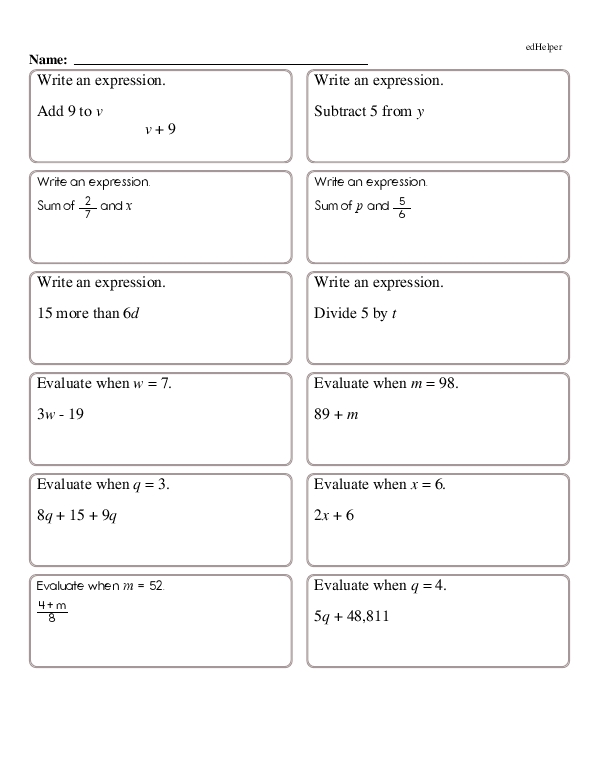
The worksheet title "Writing Expressions for One-Variable Equations" asks students to write expressions for equations that include one variable. Fifth-grade worksheets include math terminology to help students develop their vocabulary. For example, students have to write an addition problem for prompts that include phrasing like "13 more than 7v," "add 3 to x," and "the sum of 2/3 and w."
Sixth-grade worksheets ask students to evaluate the equation when given the value of the variable. For example, one problem might be 19-3w, with directions that read "Evaluate when w=5."
Each page includes 12 individual problems. Each problem is contained in a rectangle with extra space for students to write their answer.
Learning how to solve problems with variables requires a firm foundation built on mathematical confidence. You can build your students' confidence by exposing them to equations with variables without asking them to solve them.
You might ask your students to write an expression based on brief directions. For example, problems might instruct students to "Add 3 to x" or state "3t less than 19." Then, they write the equation.
As students get practice learning what to do with the numbers that are displayed in variable equations, they can begin solving for the letter when the value of the letter is provided. For example, they might solve 86+q when q=35. More difficult problems might feature the same letter more than once and, when students are ready, include two letters with given values. Once they have built their confidence in solving these kinds of problems, they can solve one-variable equations when the letter isn't given.
Writing Expressions for One-Variable Equations
Additional Educational Resources:
Algebraic Expressions Large Workbook - (Grade 6)
Equations and Inequalities Large Workbook - (Grade 6)
Quick Assessment - Beginning Algebra: Exploring Algebraic Expressions - Variables, Expressions, and Equations
Quick Assessment - Mastering Percent Calculations: Real-World Percents
Writing Expressions for One-Variable Equations
GRADES:

Additional Educational Resources:
Algebraic Expressions Large Workbook - (Grade 6)
Equations and Inequalities Large Workbook - (Grade 6)
Quick Assessment - Beginning Algebra: Exploring Algebraic Expressions - Variables, Expressions, and Equations
Quick Assessment - Mastering Percent Calculations: Real-World Percents