

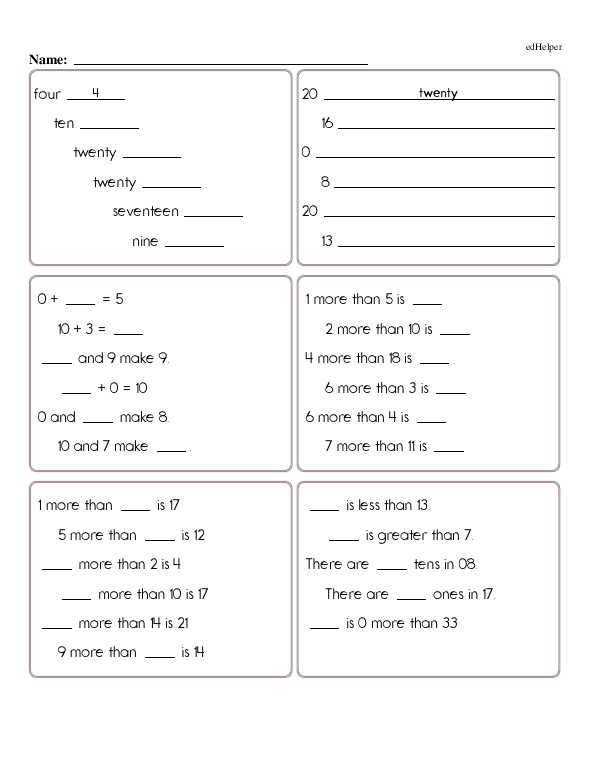
The worksheet titled "Writing Numbers and Fill-in-the-Blank Math Phrases" invites students to think deeply about numbers in different ways.
Each worksheet starts by writing out a list of numbers that are spelled out with letters. Students fill in the blank with the correct digits. The section on the right does the opposite. The digits are given, and students must spell out the number. Numbers range from 0 to 100, with smaller numbers in lower grades and larger numbers in higher grades.
Additional problems use math terminology in a fill-in-the-blank format. For example, one question might ask, "7 more than 9 is ___." Other questions ask about place value, like how many tens are in a number, as well as filling in the blank in algebra-like problems such as "___+1=11." Both addition and subtraction terminology are used with some basic math problems, like "60+2=___" mixed in.
Learning to add and subtract is a foundational mathematical skill, but students can benefit from digging deeper and thinking about numbers in new ways.
For example, students should be able to identify a number that's written out, in addition to recognizing numbers that are written with digits. They should understand that terms like "more than" or "greater than" indicate addition is taking place, while "less than" indicates subtraction is taking place.
Having students complete worksheets with fill in the blanks can help them solidify these concepts. A few examples include "1 more than ___ is 8" and "___ is less than 56."
Students can write their own fill-in-the-blank puzzles for their classmates to complete, or they can be incorporated into another puzzle, like a crossword.
Writing Numbers and Fill-in-the-Blank Math Phrases
Writing Numbers and Fill-in-the-Blank Math Phrases
GRADES:

Additional Educational Resources:
Addition up to 1,000 Large Workbook - (Grade 2)
Estimation and Number Theory Large Workbook - (Grade 4)
Quick Assessment - Two-digit and Three-digit Addition - Bigger Numbers, Bigger Sums
Quick Assessment - Fun Mental-Math Workbook in Easy Addition