edHelper.com
Immigration
United States Immigration Laws in the 18th and 19th Centuries


United States Immigration Laws in the 18th and 19th Centuries
Reading Level
     edHelper's suggested reading level:   grades 7 to 9
     Flesch-Kincaid grade level:   10.89

Vocabulary
     challenging words:    foreign-born, comprehensive, devastation, citizenship, legacy, barred, nineteenth, federal, administration, manifest, poverty, docked, industry, gain, government, moral
     content words:    United States, Revolutionary War, Naturalization Act, Anti-Coolie Act, Chinese Exclusion Act, Contract Labor Law, Immigration Act, Treasury Department, Justice Department, Naturalization Service


Print United States Immigration Laws in the 18th and 19th Centuries
     Print United States Immigration Laws in the 18th and 19th Centuries  (font options, pick words for additional puzzles, and more)


Quickly Print - PDF format
     Quickly Print: PDF (2 columns per page)

     Quickly Print: PDF (full page)


Quickly Print - HTML format
     Quickly Print: HTML


Proofreading Activity
     Print a proofreading activity


Feedback on United States Immigration Laws in the 18th and 19th Centuries
     Leave your feedback on United States Immigration Laws in the 18th and 19th Centuries  (use this link if you found an error in the story)


United States Immigration Laws in the 18th and 19th Centuries
By Sheri Skelton
  

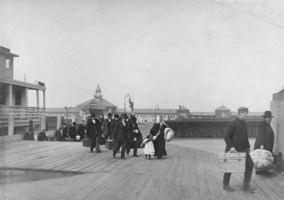
1     The United States is a country with a legacy of immigrants who traveled to America to escape the devastation of war and the hardships of poverty or famine. Some people came seeking religious freedom while others looked to the new land for opportunities to make their fortunes. For many years people entered the country freely with no restrictions placed on the numbers allowed to come in.
 
2     After the Revolutionary War, the federal government created laws relating to immigration. The first law was the Naturalization Act of 1790, which established guidelines for aliens, or foreign-born residents, to become citizens. "Free white persons" of "good moral character" would automatically gain citizenship with a two-year residency.
 
3     In 1795 another naturalization act extended the residency requirement to five years and also mandated that people desiring to be U.S. citizens renounce their allegiance to their country of birth. Three years later the residency requirement was increased to fourteen years. The Naturalization Act of 1798 also stated that any foreigners identified as dangerous could be deported. In 1802 the residency requirement was reduced to five years.
 
4     As immigrants continued to flow into the country, the government adopted a reporting rule in 1819 to keep records of the new arrivals. When a ship docked, the captain had to submit a manifest that listed all immigrants on board. In an annual report to Congress, the Secretary of State would then disclose the number of immigrants admitted during the previous year.

Paragraphs 5 to 13:
For the complete story with questions: click here for printable


Copyright © 2009 edHelper