edHelper.com
The 1990's


A New View of Space


A New View of Space
Reading Level
     edHelper's suggested reading level:   grades 7 to 9
     Flesch-Kincaid grade level:   7.65

Vocabulary
     challenging words:    halted, telescopic, secondly, launches, incorrect, focal, further, launched, spacecraft, reality, payload, atmosphere, corrective, turbulence, billion, launching
     content words:    Twinkle Little Star, Lyman Spitzer, World War II, National Academy, United States, Orbiting Astronomical Observatory, Large Orbiting Telescope, Large Space Telescope, Edwin Hubble, Perkin-Elmer Company


Print A New View of Space
edHelper.com subscriber options:
     Print A New View of Space  (font options, pick words for additional puzzles, and more)

     Quickly print reading comprehension

     Print a proofreading activity


Feedback on A New View of Space
     Leave your feedback on A New View of Space  (use this link if you found an error in the story)


A New View of Space
By Jane Runyon
  

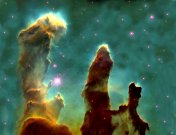
1     Have you ever stood outside on a warm summer night and watched the stars overhead? When you were younger, you might have sung "Twinkle, Twinkle Little Star" as you watched the light turn off and on. Can you tell what a star looks like by watching in your yard? Can you see how big the star is or how far away it is? Scientists weren't satisfied with just looking at the stars from their yards. They developed powerful telescopes with highly polished mirrors to bring the stars closer to their view. By the 1900's, scientists were not satisfied with the telescopes they had. They wanted more powerful telescopes. They wanted those telescopes to be placed in space. They wanted clear views of what is in space.
 
2     In 1946, astronomers were ready to get some of the answers they wanted about space. A noted astronomer named Lyman Spitzer wrote a paper read by his colleagues around the world. He wanted scientists to build a telescopic camera that could be launched into space. He had two basic reasons for his idea. First of all, a telescope in space would not be affected by the turbulence in the atmosphere that causes the stars to look like they are twinkling to eyes here on Earth. Secondly, he believed that the telescope would be able to pick up forms of light, like ultra-violet rays, that are normally absorbed by the atmosphere.
 
3     World War II brought about the development of rocket power. Until that time, space travel had been just a fantasy. Now scientists were developing a form of transportation that would make that fantasy a reality. In 1962, the U.S. National Academy of Sciences recommended that the creation of a space telescope become one of the goals for the new space program in the United States. Lyman Spitzer was appointed to head the committee formed to create the objectives needed to accomplish this feat.

Paragraphs 4 to 9:
For the complete story with questions: click here for printable


Copyright © 2008 edHelper