edHelper.com
Renaissance


Lorenzo de'Medici


Lorenzo de'Medici
Reading Level
     edHelper's suggested reading level:   grades 6 to 8
     Flesch-Kincaid grade level:   9.17

Vocabulary
     challenging words:    humanism, city-state, astrology, economic, influential, patron, defeat, attempt, philosophy, political, economy, amusement, member, lasted, court, literature
     content words:    Platonic Academy, Luigi Pulci, Giovanni Pico, Making Florence


Print Lorenzo de'Medici
edHelper.com subscriber options:
     Print Lorenzo de'Medici  (font options, pick words for additional puzzles, and more)

     Quickly print reading comprehension

     Print a proofreading activity


Feedback on Lorenzo de'Medici
     Leave your feedback on Lorenzo de'Medici  (use this link if you found an error in the story)


Lorenzo de'Medici
By Sharon Fabian
  

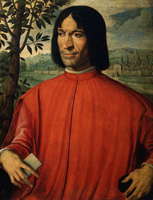
1     Lorenzo de'Medici was a Renaissance poet. His poetry wasn't the most well-known, but Lorenzo de'Medici himself had a great influence on Renaissance literature. That was because he was also a patron of the arts, someone who supported artists financially and helped them to earn a living by creating art. He supported artists in the fields of visual arts, music, and literature.
 
2     Lorenzo was born in 1448 to a family of influential leaders in Florence. His parents and grandparents had been leaders of the city-state before him. Lorenzo was given a good education; he studied Latin, Greek, and philosophy. He learned to appreciate art, music, and good writing. He began to write his own poetry in the everyday language of Tuscany, the area around Florence, rather than in formal Latin. He wrote poems about love and the good things in life.
 
3     When he became ruler, Lorenzo held festivals, balls, and tournaments to entertain the citizens and also to attract more people to Florence. Famous artists, musicians, and writers came to stay at his court. Leonardo da Vinci, Michelangelo, and Botticelli were some of the most famous artists that he sponsored.
 
4     He also sponsored writers. His group of creative friends became known as his Platonic Academy. Some of the writers included Poliziano, Luigi Pulci, and Giovanni Pico della Mirandola.

Paragraphs 5 to 11:
For the complete story with questions: click here for printable


Copyright © 2008 edHelper