

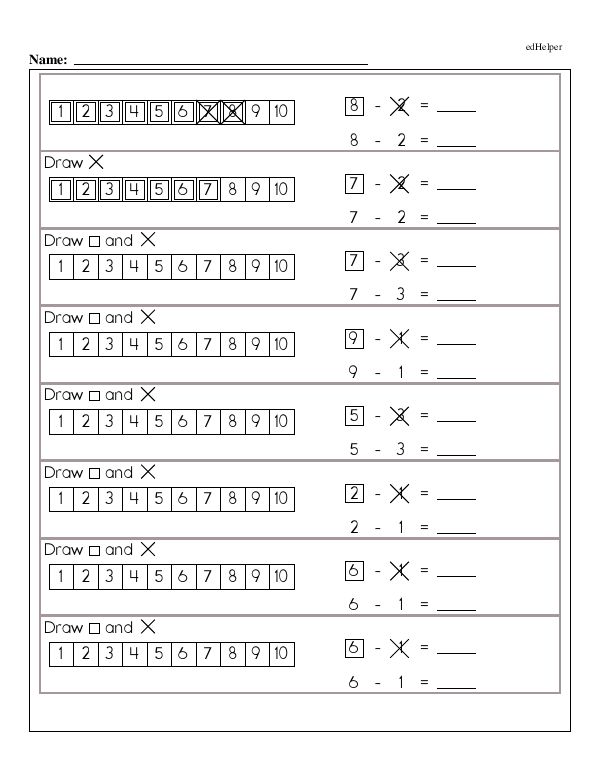
The worksheet titled "Addition and Subtraction on a Number Line: Identifying Addends, Minuends, and Subtrahends" allows students to practice math facts in a visual way so they can see the mechanism behind addition and subtraction in action. Each math problem is listed on the right side of an enclosed rectangle with a ten-frame on the left. Students begin by drawing a box around the number that represents the first number in the problem on the ten frame. They draw an X on the subtrahend in subtraction problems and a circle on the addend in addition problems.
Lower-level problems give students both digits in the problem, and they have to find the answer. As problems get more difficult, students may be required to find the addend, minuend, or subtrahend. More difficult problems also feature two ten frames that feature digits in math problems up to 20.
Each page features two examples at the top so students can see how to complete each problem. The first has boxes surrounding each number with X's or O's, depending on whether it's an addition or subtraction problem. The next example just features boxes, and students cross out or circle the correct numbers. Then, the students perform both tasks on the rest of the worksheet.
Students should eventually memorize basic addition and subtraction facts, but first, they must learn how the mechanism of addition and subtraction works. That way, they can tackle more complex problems as they get older with confidence.
Visual aids like number lines and ten frames can make the process much easier. Students can start with a number and count up or down to find an answer, seeing exactly how numbers are added or taken away. Students can do this with removable markers, or they can cross out or circle numbers on a worksheet.
Snap cubes can be helpful, too. Students are able to physically add and subtract cubes to get the answer to addition and subtraction problems.
Addition and Subtraction on Ten Frames: Identifying Addends, Minuends, and Subtrahends
Addition and Subtraction on Ten Frames: Identifying Addends, Minuends, and Subtrahends
GRADES:


Additional Educational Resources:
Addition up to 1,000 Large Workbook - (Grade 2)
Using Bar Models: Addition and Subtraction Large Workbook - (Grade 2)
Quick Assessment - Addition - Adding One and Two - What Number Comes Next?