

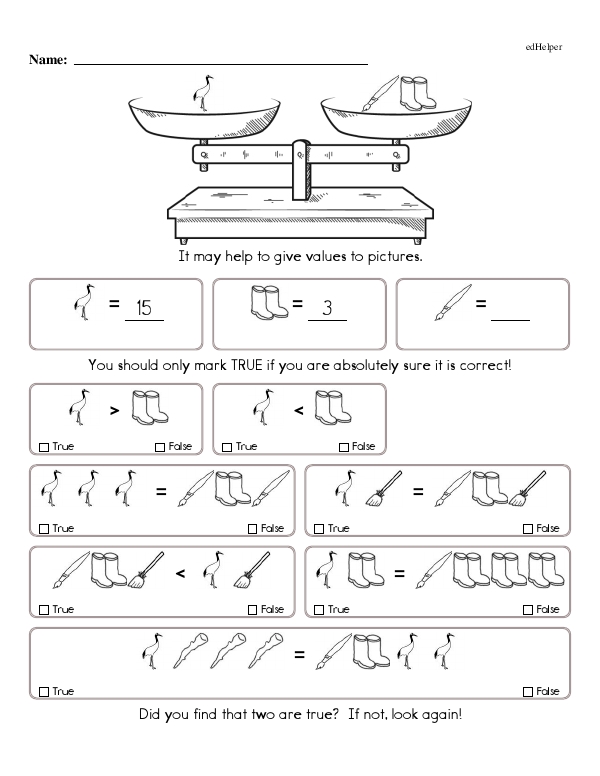
"Comparing the Weights of Objects: Symbolic Reasoning, True-False Statements, and Relational Comparison" is a fun activity that encourages students to use their critical thinking skills. Objects are displayed at the top of the page to demonstrate equality. Then, students see relational comparison problems using greater than, less than, or equal to, and decide if it is true or false.
For example, a kiwi bird and a ball equal two cockatiels. Students then see equations down below, like one kiwi bird and three balls equals two cockatiels and one ball. They have to determine whether that equation is true or false.
Some pages give number values to the objects so students can practice their symbolic reasoning skills. For example, if an otter equals 10 and a squirrel equals 17, is it true or false that the squirrel is greater than the otter? Some problems also introduce objects that aren't displayed on the scale, and because their weight is unknown, the equation must be false.
There are various prompts on each page to help students as they work. Those with numbers start by stating, "It may help to give values to pictures." The bottom of the page may ask something like, "Did you find that two are true? If not, look again!" so students can double-check their work.
Using symbolic reasoning can be a good way for students to practice seeing multiplication as equal groups. For example, instead of showing students 2+2+2=6, you could show that three birds equal 6, which means each bird must equal 2. Then, students could write the corresponding multiplication problem, which is 2x3=6.
You can create a visual activity that promotes relational comparison and symbolic reasoning by showing a scale with different objects that equal each other. You could show different combinations of those objects and indicate whether they are greater than, less than, or equal to each other, allowing students to write whether each statement is true or false. Additional activities could include assigning numbers to each image, as well as drawing their own scales and objects to show which side is heavier and which side is lighter.
Comparing the Weights of Objects: Symbolic Reasoning, True-False Statements, and Relational Comparison
Comparing the Weights of Objects: Symbolic Reasoning, True-False Statements, and Relational Comparison
GRADES:
Additional Educational Resources:
Equations and Inequalities Large Workbook - (Grade 6)
Mass Large Workbook - (Grade 2)
Quick Assessment - Comparing Quantities: Ratios & Proportions
Quick Assessment - Geometry Challenge - Shapes, Flips, and Turns