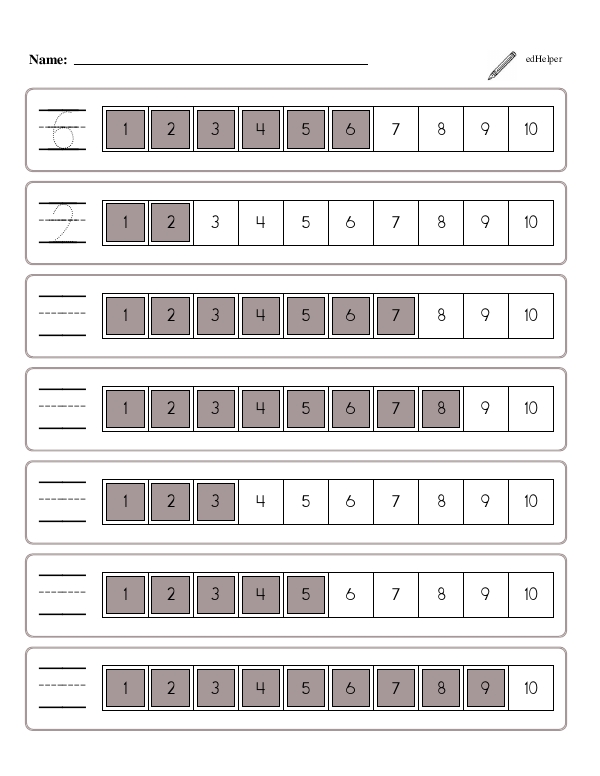
This worksheet features seven lines of ten boxes with multiple ways to solve, enabling teachers to differentiate instruction throughout the year or based on ability level.
Versions of the activities on these worksheet pages include:
* Count the shaded and numbered boxes and write the number on the line.
* Trace the number on the line and shade in the number of boxes the number represents.
* Trace the number on the line, shade in the number of boxes the number represents, and write the numbers 1 to 10 in the shaded and unshaded boxes.
* Count the number of shaded boxes, write the number on the line, and write the numbers 1 to 10 in the shaded and unshaded boxes.
All worksheet pages include one or two examples at the top of the page so students can see exactly how to do it. Examples can include numbers that can be traced, boxes that are already shaded in, and numbers 1 to 10 already written, depending on each particular worksheet.
Counting and writing numbers are among the first important tasks students are asked to do because they help students memorize number order, practice counting, and practice fine motor skills to write each number clearly.
Varying activities help students expand their thinking, in addition to keeping their interest. For example, instead of having them write the numbers on a number line, you can have them write up to a certain number, like writing the numbers 1 to 7 or 5 to 15. They can practice writing numbers on handwriting lines, in different sizes, or in grids instead of in a line.
Incorporating unique writing utensils and opportunities to be creative can also encourage students to focus. They can complete a worksheet with a crayon or a colored pencil, or they can draw specific shapes around numbers. For example, if they have to count to 6, they could draw hearts around the first 6 numbers on a number line that displays the numbers 1 to 10.
Count the Squares and Write the Number
Count the Squares and Write the Number
GRADES: