

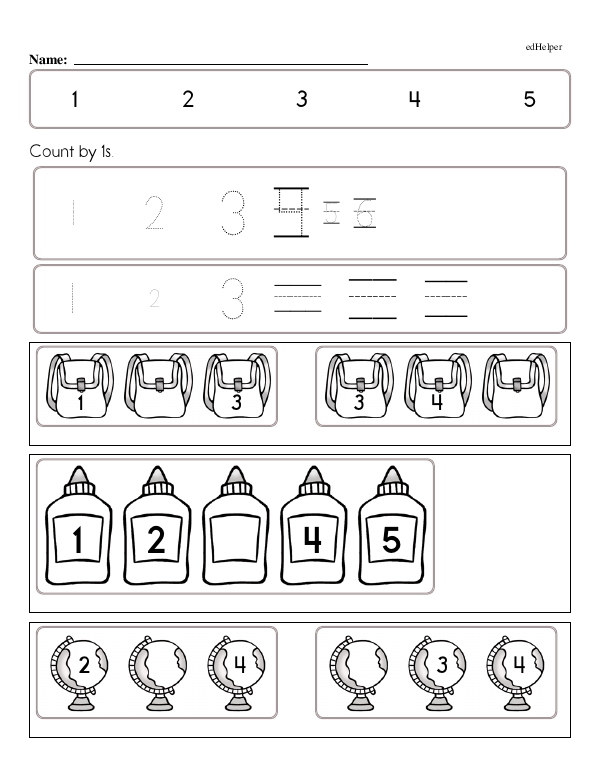
These worksheet pages instruct students to count by ones or twos. The first activity asks students to trace the numbers. Then, they trace the first three numbers and write the next three numbers on the line. For example, if the directions say to "Count by 2s," students would trace 2, 4, 6, 8, 10, and 12. Then they would trace 2, 4, and 6 before writing 8, 10, and 12 on the lines.
The last section of the worksheet features sets of images in rectangles. Students fill in the missing numbers according to whether they're counting by ones or twos. For example, they would fill in the number 6 on a set of three turtles where the numbers 4 and 8 are already shown.
Each page includes a number line at the top that displays the numbers according to how students will be counting. So, pages where students count by ones might feature the numbers 1-10. Pages where students count by twos might feature the numbers 2, 4, 6, 8, 10. Some number lines stop at 10, while other number lines go up to 20 depending on the numbers the students are working with on the worksheet.
Skip counting forms the basis for multiplication, making it an important skill for students to develop. Very young students can practice their skip counting skills by counting by twos and seeing how it compares to counting by ones.
Students can trace the numbers or write the numbers on a number line, counting by twos. They can also fill in the missing numbers, like filling the number 4 in the line 2, ___, 6, 8, 10.
You can give students a number line of multiples of two and ask them to fill in the numbers in between. This activity can also provide you with an opportunity to talk about even and odd numbers.
Counting By Ones and Twos: Tracing and Writing Numbers
Counting By Ones and Twos: Tracing and Writing Numbers
GRADES:

Additional Educational Resources:
Numbers to 20 Large Workbook - (Grade 1)
Making Groups (Multiplication and Division Ideas) Large Workbook - (Grade 1)
Quick Assessment - Exploring Numbers to 20