

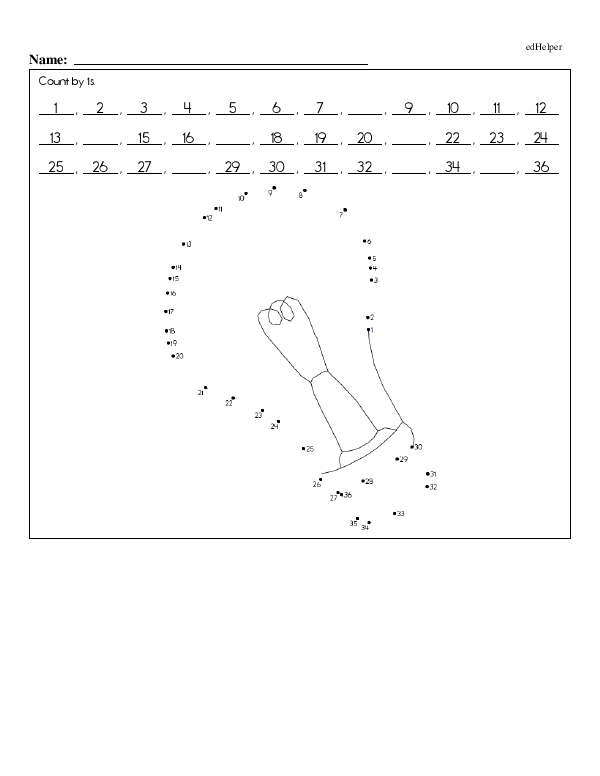
"Counting and Skip Counting Connect the Dots Puzzles" is a worksheet that asks students to connect the dots to reveal an image.
The top of each page instructs students how to count the numbers. Kindergarten pages ask students to count by 1s. Higher grade levels ask students to count by 2s, 3s, 4s, 5s, or 6s.
Then, the numbers are listed in order with blanks for students to fill in. For example, if asked to count by 6s, the numbers listed would be 6, 12, a blank, 24, 30, and so on. Students fill in the blank with the missing number. In this case, they would fill in the number 18.
At the bottom of each worksheet is a series of dots labeled with the numbers that are listed in the sequence above. Students connect the dots in numerical order to reveal the image. So, for example, if students are counting by 2s, they would connect the dots 2, 4, 6, 8, and so on.
Very young students learn number sense when they learn how to count by ones, while older students can learn the basis of multiplication by learning how to skip count. Skip counting also enables students to learn how to identify number patterns.
Simple activities that ask students to fill in the numbers on a number line or list out all the numbers from 1 to 10 (counting by twos) can be an easy way to get started. As students get better at skip counting, they can skip count starting with tricky numbers. For example, they could skip count by 2s starting with the number 1, or you could ask them to count by 3s starting with the number 21.
You can find puzzles, brain teasers, and games that help students develop number sense, counting, and skip-counting skills. Connect-the-dot activities can be a fun way for students to practice counting by 1s, 2s, and other patterns. Students can arrange number cards in order or play a board game where they have to write the numbers they land on in the right order on their worksheet.
Counting and Skip Counting Connect the Dots Puzzles
Counting and Skip Counting Connect the Dots Puzzles
GRADES:

Additional Educational Resources:
Numbers to 100 Large Workbook - (Grade 1)
Making Groups (Multiplication and Division Ideas) Large Workbook - (Grade 1)
Quick Assessment - Geometry Challenge - Shapes, Flips, and Turns