

The worksheet titled "Finding Two Parts in a Whole: Visual Addition Practice" features multiple number bonds. Lower grade level worksheets start with three bubbles. Both parts are shown visually with blocks in sets of five so students can count the numbers that go in the part bubbles. Sometimes the whole number is shown, and the students have to count the blocks to find the two parts that equal that number. Sometimes the parts are given, and students must fill in the whole. Eventually, the blocks are not included, and students must figure out the parts and whole without a visual aid.
Upper-grade level worksheets focus on number combinations that have the same answer. For example, the number 17 would be located in the answer bubble in three different number bonds. One answer bubble is filled in, and students have to fill in the other bubble, demonstrating three different ways to make the same number.
Students who practice addition using visual aids are more likely to understand and retain the knowledge they're learning. It's also a great way for students to understand mathematical concepts deeply, instead of just learning the operation of addition at a surface level.
Using blocks, markers, or other countable materials is a great way for students to visualize numbers. That's especially true when the manipulatives are organized in groups of five or ten, so students practice adding groups instead of counting by ones.
Number bonds are also an effective way for students to visualize addition. Students can find the answer when given two parts or find one or more parts when the answer is given. They can find multiple parts for number bonds with the same answer, they can see how addition relates to subtraction, and they can even answer number bonds with more than two parts as they master the strategy.
Finding Two Parts in a Whole: Visual Addition Practice
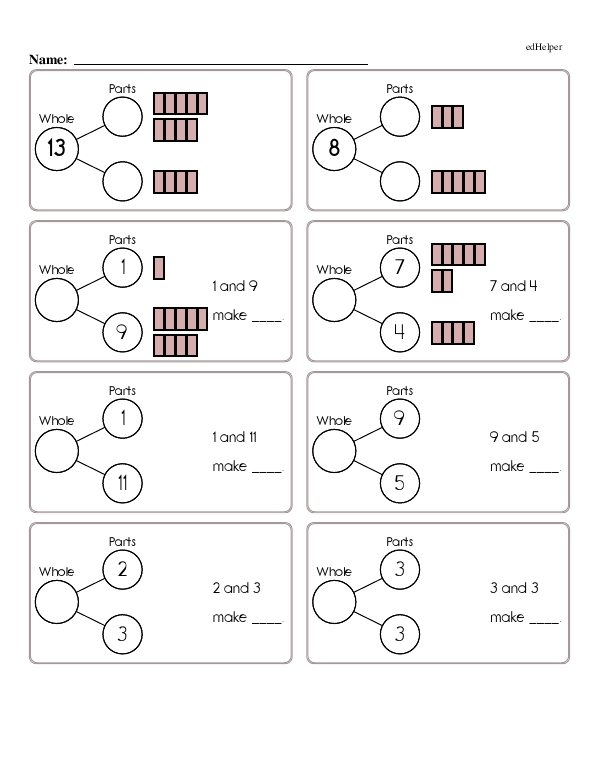
Finding Two Parts in a Whole: Visual Addition Practice
GRADES:

Additional Educational Resources:
Addition Facts to 10 Large Workbook - (Grade 1)
Using Bar Models: Addition and Subtraction Large Workbook - (Grade 3)
Quick Assessment - Fun Mental-Math Workbook in Easy Addition
Quick Assessment - Money Challenge (difficult): The Ultimate Coin & Dollar Challenge