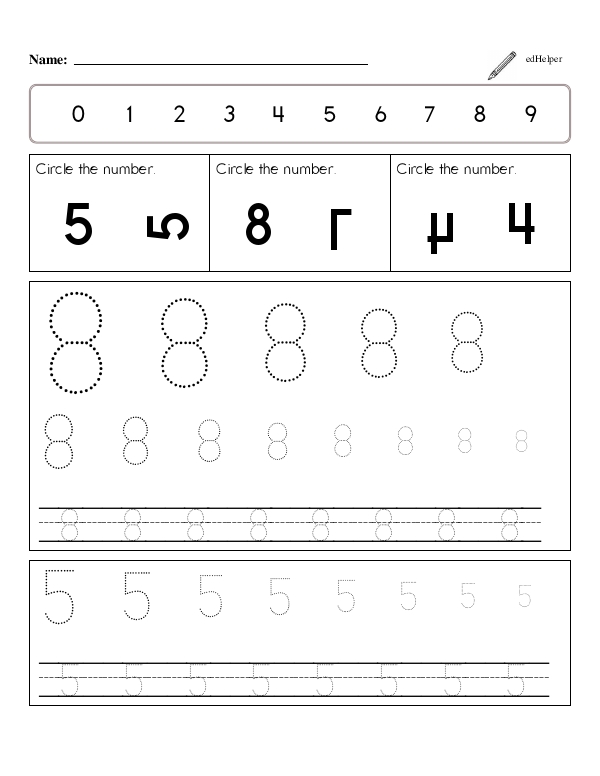
This worksheet gives early learners multiple ways to practice their number knowledge and fine motor skills. It features multiple sections that include:
* A horizontal list of numbers from 0 to 9 that students can look at while they work.
* Three sections that ask students to circle the number. Each section includes two options, one of which is the correct number, and the other can be the same number upside down, a symbol, or a letter.
* Below are two sections where students can practice tracing two of the numbers they circled above. They trace dotted numbers in various sizes, then trace the dotted numbers on the practice lines.
Each section is enclosed within a square or rectangle so students can work on one problem at a time. The circling activity includes directions with each box instructing students to "Circle the number."
Being able to recognize and write numbers is the earliest mathematical skill that young students should master because it will help them count and complete equations.
Students can practice identifying numbers when they're jumbled up with other symbols, like the greater than symbol, equal sign, or letters. You can increase the difficulty by including numbers in the wrong orientation, like a backward 6 or a sideways 8.
You should also have students practice writing numbers. They can write numbers on their own, but very young students can start by tracing numbers. Not only does this help them memorize the way numbers look, but it also supports fine motor skills. Include traceable numbers in different sizes, and you can use the activity as an informal assessment to see which students need more practice with their fine motor skills, or as a referral if you think the student needs extra support.
Identifying and Tracing Numbers 0 to 9
Identifying and Tracing Numbers 0 to 9
GRADES: