

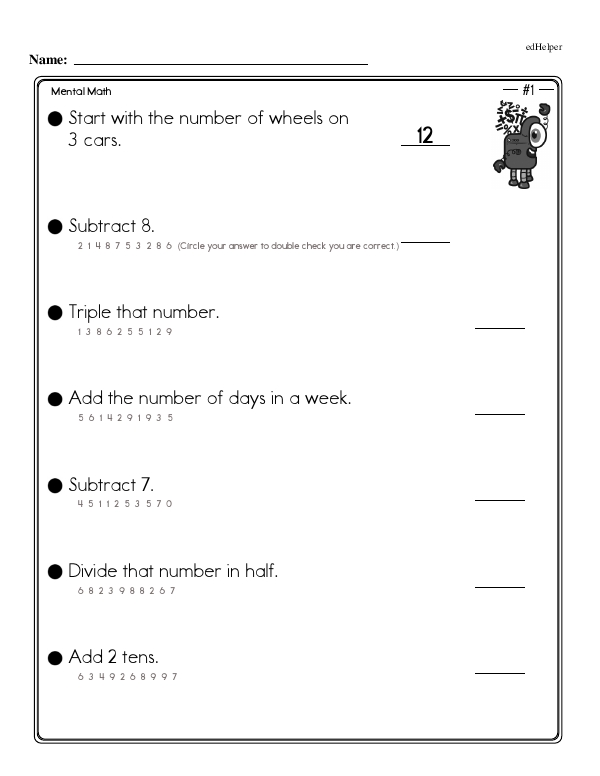
"Mental Math Practice with Multiple Steps" is a worksheet that features step-by-step mental math problems that students must solve one at a time in order to get the correct final answer. Each page starts with a given number before students answer between 7 and 11 instructions on what to do with that number next. For example, students might start with the number 112. They must divide that number in half. Then, they add 3 tens, and so on.
Each step includes a series of numbers that contain the answer underneath. If students can circle the answer they got, they know they answered that particular step correctly. Each step also includes a blank where students can write their answer.
Problems ask students to do a wide range of grade-level appropriate tasks like:
* Adding, subtracting, multiplying, and dividing
* Halving, doubling, and tripling numbers
* Increasing and decreasing numbers
* Incorporating other math terms, like dozens, tens, and hundreds
* Other measurements, like ounces and counting money
* Utilizing common knowledge, like adding the number of wheels on a car
Students who are able to do math mentally have more confidence, which is especially important when it comes to solving more complex math problems. They are more likely to tackle difficult problems without shutting down when they know they are proficient enough at math that they can do many operations mentally.
You can give students practice with mental math in your classroom by providing them with worksheets that ask them to solve step-by-step problems one question at a time. Each step can feature something you're working on in class. For example, you might ask students to add a group of tens if you're working on place value or add the number of dimes in a dollar if you're working on a unit on money.
Verbal activities can also be effective. Read aloud each step of a mental math problem and ask students to write down their answer. By reading them aloud, you can pace the problems quickly enough that students aren't tempted to write down the problem. It's best to do this in a small group with students who are at a similar stage of learning to avoid having students who get frustrated and shut down. You can adjust the pace and type of questions for each group to match their learning level.
Mental Math Practice with Multiple Steps
Mental Math Practice with Multiple Steps
GRADES:


Additional Educational Resources:
Multiplication and Mental Math Large Workbook - (Grade 2)
Mental Math and Estimation Large Workbook - (Grade 3)
Quick Assessment - Fun Mental-Math Workbook in Easy Addition
Quick Assessment - The Decimal Toolbox: Adding and Subtracting Money and Decimals