

The worksheet "Multi-Digit Place Value Challenge" asks students to time themselves as they solve place value problems. There is a spot at the top of the page where they can write their starting and ending times.
Each worksheet page features 21 place value challenges with blanks for each of the digits that students have to fill in. Each statement combines numbers written as digits, numbers written as words, and place value language. For example, one question might ask students to fill in the number that represents "99 ones," while another might ask "the number ten greater than 76." Place values students have to identify include tens, hundreds, thousands, and ten thousands.
It is important for students to become proficient with place value concepts, as it forms the basis for all operations. The more practice students get at analyzing place value, the more confident they will become at identifying numbers and finding the correct answer to both simple and complex math problems.
An easy way to get started involves asking students to identify the digits in each place value. For example, in the number 325, you can ask students which digit represents the ones, tens, and hundreds places.
As students begin to develop place value number sense, you can provide them with more challenging questions to answer. For example, you could ask them what 13 ones is or what 76 hundreds is. You can incorporate other concepts, like greater than and less than, by asking what number is one hundred greater than 4,200.
Using manipulatives can be a powerful and fun way for students to practice place value. They can move around number cards to display specific numbers, like five hundreds, two tens, and nine ones.
Multi-Digit Place Value Challenge
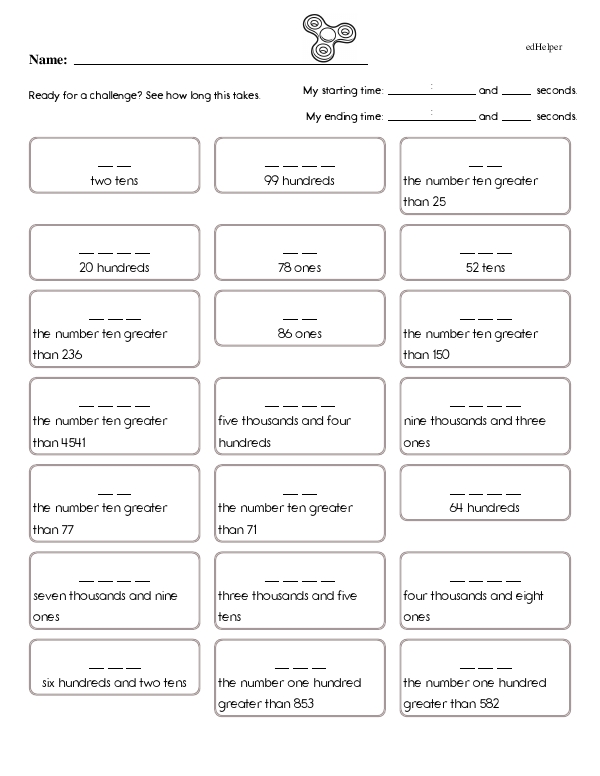
Multi-Digit Place Value Challenge
GRADES:
Additional Educational Resources:
Numbers to 1,000 Large Workbook - (Grade 2)
Mental Math and Estimation Large Workbook - (Grade 3)
Quick Assessment - Mastering Subtraction
Quick Assessment - Fun Mental-Math Workbook in Easy Addition