

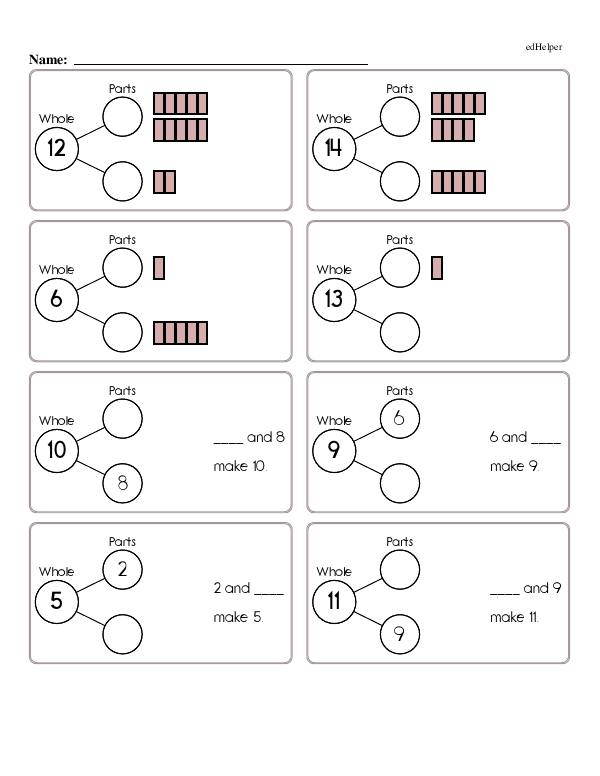
"Number Bonds: Visual Parts, Different Parts With the Same Answer, and More" is a worksheet that encourages students to visualize addition problems using number bonds that feature a whole bubble and at least two part bubbles.
Kindergarten worksheets build foundational understanding with number bonds that have the whole filled in. Sometimes one part is filled in with a number, and they have to find the other number. Sometimes blocks are added that students can count before filling in the parts. Equations without blocks feature a sentence with a blank that they must fill in, like "4 and ___ make 11," based on the number bond they completed.
First-grade worksheets focus on showing students different combinations of parts that equal the same whole. For example, students are presented with three different number bonds where the answer is 9. For example, a set of number bonds for 9 would be 8 and 1, 7 and 2, and 5 and 4.
Second- and third-grade pages give students a list of numbers to choose from. They have to pick the numbers that go in each whole or part bubble. Some number bonds include three parts to provide an added challenge.
Helping students visualize addition can help them become more fluent mathematicians. It can also build confidence and understanding when students can see the mechanism behind addition instead of just counting on their fingers.
Number bonds are a great tool, especially if you want students to practice visual addition on a worksheet. There are many ways for students to practice with number bonds:
* You can give students the whole and they can find the parts, or you can give them the parts and they can find the whole.
* Parts can be accompanied by markers on the sheet that students have to count
* The number bond can have three or more parts.
* You can create sets of number bonds with the same answer, so students can see which combinations of parts equal the same number.
* You can help them see how a number bond relates to subtraction by giving them the whole and one part.
* You can create a multi-layered number bond to see how different numbers and equations relate to one another.
Number Bonds: Visual Parts, Different Parts With the Same Answer, and More
Number Bonds: Visual Parts, Different Parts With the Same Answer, and More
GRADES:
Additional Educational Resources:
Addition Facts to 10 Large Workbook - (Grade 1)
Using Bar Models: Addition and Subtraction Large Workbook - (Grade 2)
Quick Assessment - Digits in Their Places: Mastering Whole Numbers and Place Value
Quick Assessment - Mental Math: Brain-Power Math Fluency