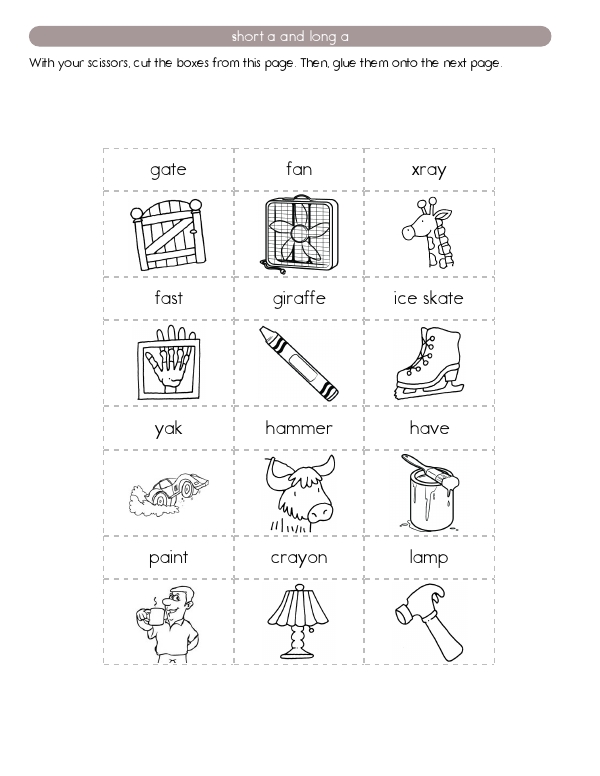
"Short and Long Vowel Practice: Cut and Match Words and Images" is a worksheet that asks students to differentiate between short and long vowel sounds with a fun cut-and-paste activity.
The first page features jumbled-up words and images enclosed in dashed boxes. Students are instructed to cut out each box. On the next page are columns for short vowel sounds and long vowel sounds. Students glue the words with the images in the correct columns. For example, students would glue the word and picture of "puppy" in the short "u" column and "soup" in the long "u" column.
Each column includes an example image that helps students identify the sound. One example is a picture of a cup in the short "u" column and a picture of a book in the long "u" column. There are outlines of each box in each column so students know where to glue pictures and words. There are the same number of boxes as images and pictures. That way, students know they're finished when all the boxes are filled.
Learning how to identify different vowel sounds can help students become better decoders when reading new words. It can also help them be more precise when speaking and writing, as the meaning of a word can change depending on the vowel sound, like the difference between "cut" and "cute."
Students can sort through different words and categorize them based on whether they make a long or short vowel sound. It's a good idea to keep the same letter sounds together. For example, students can practice categorizing words based on whether or not they have a short or long "o" sound instead of comparing the short "o" sound to the short "a" sound.
Images can help keep students engaged. They can organize images instead of words according to their sounds, or they can match the words to the images before categorizing them.
You can create a worksheet where students draw lines from different words or check boxes according to their vowel sounds. Students can fill in the correct vowels into words with blanks or only color the pictures according to the type of letter sound they're identifying, leaving the other pictures uncolored.
Short and Long Vowel Practice: Cut and Match Words and Images
Short and Long Vowel Practice: Cut and Match Words and Images
GRADES: