

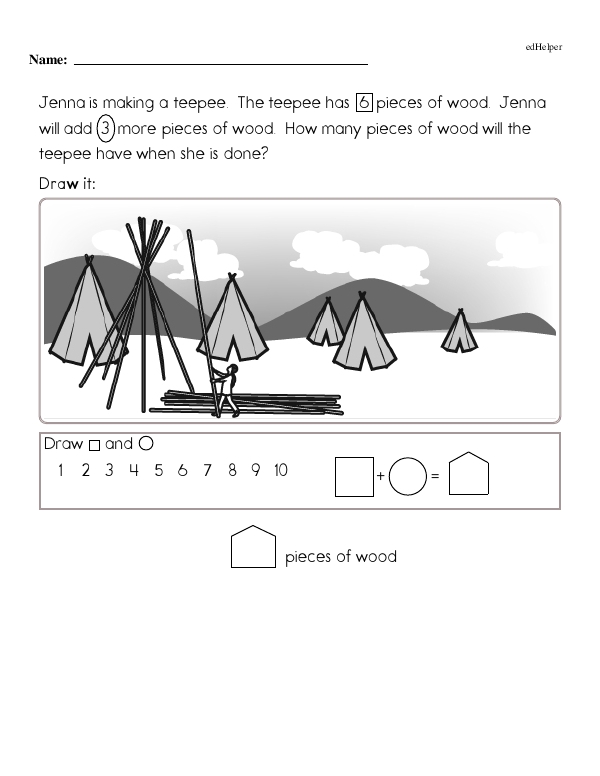
The worksheet "Writing, Drawing, and Counting Addition and Subtraction Problems" starts with an addition or subtraction word problem. Each of the digits in the word problem is enclosed in a shape. For example, a problem about treat bags features a square around the number 5 and an oval around the number 3 before asking how many there are in all.
Below the word problem is a section where students get to draw the problem. At least one section is completely blank, while others include dotted lines and other details of the image that students can trace and add to.
The next section shows the problem in two different ways. Students count on using shapes in an addition problem. For example, they would draw squares around the digits up to five, then draw an oval around 6, 7, and 8 before writing the answer. Subtraction problems have students draw shapes around the numbers in the problem and cross out how many they're subtracting. At the bottom of a page is a place where they can write the answer to the problem.
Practicing beginning addition and subtraction skills using images can help students visualize what's happening, which helps them develop better number sense.
Shapes can be a powerful way for students to practice. For example, an addition problem can have a square around one number and a circle around another. Then, students enclose numbers on a number line to find the answer. For a problem like 5 + 2, students would draw squares around the numbers one through five, then draw circles around numbers 6 and 7 to find the answer.
You can ask students to draw a picture that goes with an addition or subtraction problem. This can be especially powerful when having students work on word problems. They can also use manipulatives by placing transparent counting chips on a number line to find the answer to a problem.
Writing, Drawing, and Counting Addition and Subtraction Problems
Writing, Drawing, and Counting Addition and Subtraction Problems
GRADES:


Additional Educational Resources:
Addition Facts to 10 Large Workbook - (Grade 1)
Subtraction Facts to 10 Large Workbook - (Grade 1)
Quick Assessment - Addition - Adding One and Two - What Number Comes Next?