

"Writing Numbers, Counting by Ones, and Skip Counting: Fall Theme" is a worksheet that is designed to help young students develop number sense.
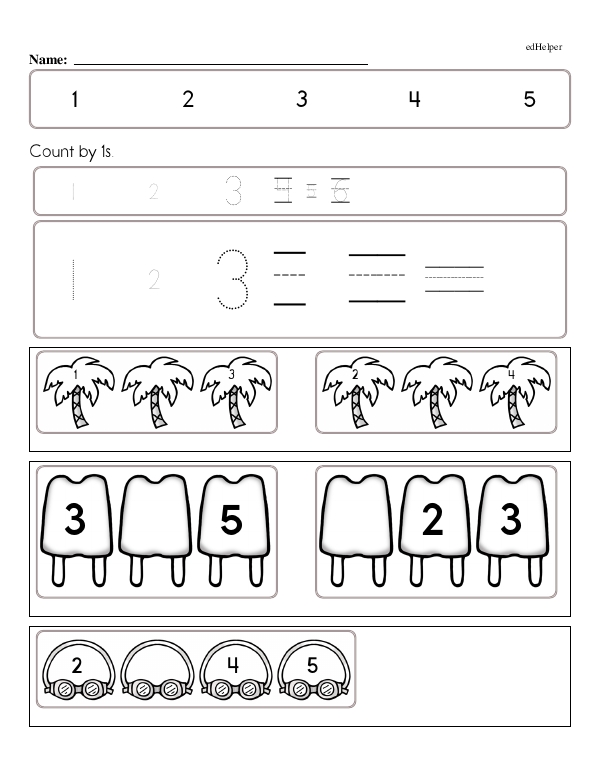
Kindergarten pages focus on having students practice counting by ones. They trace dotted lines to write numbers and finish writing the numbers 4, 5, and 6 in a sequence. Then, they see fall-friendly images below with some numbers filled in. They have to fill in the missing number in the sequence. For example, a sequence of acorns could contain 1, a blank, 3, 4, and 5. Students fill in the blank with the number 2.
Tasks are similar on first-grade pages, but instead of counting by ones, first graders are asked to skip count. They are asked to skip count by 3s, 5s, 2s, and 4s, depending on the page. They trace the numbers in the pattern, write them in a sequence, and fill in the missing numbers in a series of images.
Each worksheet page displays the number line that is being used, whether it counts by ones or skip counts, for students to reference. The numbers 1-5 are displayed in order for kindergartners, while the number line reflects the pattern first graders are supposed to follow. For example, if students are being asked to count by 2s, the number line would list 2, 4, 6, and so on until it reaches the highest number being displayed on the worksheet.
It's important to help young students build a clear sense of numbers and their order. For very young students, that means learning to count by ones. For older students, it means learning to skip count.
For example, young students should be able to write the numbers 1 to 10, and then 1 to 20, and so on. You can check for understanding by giving students a list of numbers, and they have to fill in the number that's missing.
Older students can learn how to skip count by 2s, 3s, 4s, 5s, and 10s. This helps them learn how to count larger numbers, but it also builds a foundation for multiplication. By filling in missing numbers, they learn more about place value. For example, you can display a series of numbers like 26, 28, a blank, 32, 34. Then, students fill in the number 30.
Writing Numbers, Counting by Ones, and Skip Counting: Fall Theme
Writing Numbers, Counting by Ones, and Skip Counting: Fall Theme
GRADES:


Additional Educational Resources:
Numbers to 10 Large Workbook - (Grade 1)
Numbers to 20 Large Workbook - (Grade 1)
Quick Assessment - Numbers to 10 - Visual Math: Exploring Numbers with Blocks and Images