edHelper.com
The 1920's
Miscellaneous Health Topics
The Race to Nome: The 1925 Alaska Serum Run


The Race to Nome: The 1925 Alaska Serum Run
Reading Level
     edHelper's suggested reading level:   grades 5 to 7
     Flesch-Kincaid grade level:   6.36

Vocabulary
     challenging words:    frostbite, life-saving, water-cooled, inscription, shack, difficulty, cargo, lining, toll, diphtheria, dogsled, untreated, visibility, weaken, saying, serious
     content words:    Frederick Roth, Central Park, New York City, New York, Holy Cross, Curtis Welch, Governor Scott Bone, Public Health Service, Washington D. C., By January


Print The Race to Nome: The 1925 Alaska Serum Run
     Print The Race to Nome: The 1925 Alaska Serum Run  (font options, pick words for additional puzzles, and more)


Quickly Print - PDF format
     Quickly Print: PDF (2 columns per page)

     Quickly Print: PDF (full page)


Quickly Print - HTML format
     Quickly Print: HTML


Proofreading Activity
     Print a proofreading activity


Feedback on The Race to Nome: The 1925 Alaska Serum Run
     Leave your feedback on The Race to Nome: The 1925 Alaska Serum Run  (use this link if you found an error in the story)


The Race to Nome: The 1925 Alaska Serum Run
By Joyce Furstenau
  

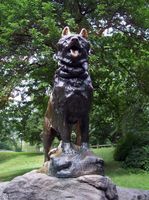
1     Caption: Statue of Balto by Frederick Roth in Central Park (New York City, New York).
 
2     Diphtheria is a serious inflammation that destroys the lining of the throat. It causes the throat and neck to swell leading to difficulty breathing. If untreated, it can lead to death in as little as four days. Anyone who is infected with the disease must be quarantined, or isolated because it is highly contagious. Fortunately, there is a vaccine that is now available to prevent the spread of this dreaded childhood disease. Unfortunately, in 1925, a diphtheria epidemic promised to wipe out the entire city of Nome if the citizens didn't receive the medicine to stop it. This illness cost the lives of several children before the antitoxin finally was delivered to Nome.
 
3     In December 1924, the first diphtheria-like illness was reported in the native village of Holy Cross, just a few miles away from Nome. The two-year old boy died the next morning. His parents, who were native Inuits, would not allow his body to be autopsied. As a result, three more children in the same area died with similar symptoms before the local doctor, Dr. Curtis Welch, could diagnose their illness as diphtheria.
 
4     On January 20, 1925, a three-year old child was properly diagnosed with diphtheria. Dr. Welch had six thousand units of antitoxin in his office but it was six years old. He feared its effectiveness had expired. Dr. Welch was afraid the antitoxin would weaken the child. It didn't matter. He died the next day.
 
5     The following day, a seven-year-old girl was diagnosed with diphtheria. She died later the same day. It was clear to Dr. Welch the town of Nome was facing an epidemic. (An epidemic is any rapidly spreading disease that attacks an unusually large number of people and spreads from town to town.) Dr. Welch called a town council meeting to discuss the situation. He told city officials he needed at least one million units of serum to hold off the spread of diphtheria. Telegrams were sent to Governor Scott Bone and the U.S. Public Health Service in Washington D.C. asking for assistance in obtaining the antitoxin By January 24, there were two more deaths and twenty more confirmed cases. The epidemic promised to wipe out the entire city of Nome if the medicine didn't arrive. Finally, serum was found in Anchorage. Governor Bone was faced with the difficult decision of how best to safely deliver it to Nome.
 
6     There were only two choices to make: deliver it by airplane or by dogsled. In their book, The Cruelest Miles, Gay and Laney Salisbury say that many Alaskans believe their state would not have developed were it not for sled dogs. They quote a sled driver as saying, "A man is only as good as his dogs when he is on the trails of Alaska...and a dog is only as good as his feet."
 
7     Governor Bone weighed the risks of both choices. The bush planes available in Alaska had open cockpits and water-cooled engines. Flying an airplane in fifty degree below zero weather was too big a risk. The board of health also rejected the use of an airplane. They voted unanimously for the dogsled relay. Governor Bone enlisted the most experienced dogsled racers to help get the serum from outside Anchorage to Nome. Only expert dogsled racers could make this journey of mercy in the middle of the worst winter since 1905. All told, there were twenty men and 150 dogs called upon to make the run. These brave drivers would have to drive a team of dogs day and night over 938 miles to bring the life-saving serum to Nome.
 
8     On Tuesday, January 27, 2006, a musher named "Wild Bill" Shannon left Nenana on the first leg of the race. He was a fearless mail driver that was known to take risks, no doubt an explanation for his nickname. He was handed the twenty-pound package at the Nenana train station. He and his nine-dog team would bring the serum from Nenana to Tolovana where another musher would take over. Because the temperature was approaching fifty below zero, by the time Shannon arrived at the first roadhouse, (a small shack where he and the dogs could rest) he had severe frostbite on his face. After resting four hours, he headed back into the storm to bring the serum to Tolovana. Three of his dogs had to be left at the roadhouse because the below freezing temperature had taken its toll on them. Shannon arrived at the roadhouse in Tolovana at 11 A.M on January 28th. The temperature was 62 degrees below zero.
 
9     The serum was warmed at the roadhouse where Edgar Kallands took over for Shannon. He drove his dogsled team through the day to make thirty-one miles by 4 P.M. The owner of the roadhouse had to pour hot water over Kalland's hands to get them free of the sled's handlebar. The serum was safely passed on through the course of the day between six drivers. They drove their dog teams day and night to complete a total distance of 170 miles before the next day arrived. Conditions were difficult. Visibility was poor at times. The trail was often covered with snowdrifts. Wind blew loose snow away to reveal a solid sheet of ice. Drivers faced blistering winds and ice fog, which is fog that is composed of ice crystals instead of water droplets. When the ice crystals hit the driver's face, it was like being stabbed by tiny bits of glass.

Paragraphs 10 to 17:
For the complete story with questions: click here for printable


Copyright © 2009 edHelper