edHelper.com
Black History and Blacks in U.S. History
A Nation Divided
(1840-1861)


Fugitive Slave Law


Fugitive Slave Law
Reading Level
     edHelper's suggested reading level:   high interest, readability grades 4 to 5
     Flesch-Kincaid grade level:   4.78

Vocabulary
     challenging words:    abolitionists, courtroom, posse, slavery, illegal, totally, federal, running, runaway, courthouse, fined, treason, jail, freedom, owner, court
     content words:    Fugitive Slave Law, United States, African Americans, Many African Americans, Shadrach Minkins, New England, Underground Railroad


Print Fugitive Slave Law
edHelper.com subscriber options:
     Print Fugitive Slave Law  (font options, pick words for additional puzzles, and more)

     Quickly print reading comprehension

     Print a proofreading activity


Feedback on Fugitive Slave Law
     Leave your feedback on Fugitive Slave Law  (use this link if you found an error in the story)


Fugitive Slave Law
By Cathy Pearl
  

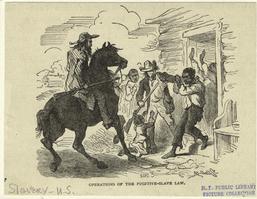
1     The Fugitive Slave Law was passed in 1850. It was part of the Compromise of 1850. It set up rules on what Northerners were supposed to do when they saw runaway slaves. The South liked the law. It helped them to get runaway slaves back. People in the North hated the law. They didn't want to be forced to send black men, women, and children back into slavery.
 
2     The law made it illegal for any person to help a slave. If an escaped slave was seen, the slave should be captured right away. The slave should then be given to authorities. After that, the slave would be sent back to his or her owner in the South.
 
3     The law let slave owners start a posse anywhere in the United States. A posse is a group of men that usually helped the sheriff. The posse would help capture a runaway slave. The courts and police had to help them.
 
4     Anyone caught helping a runaway slave could get into a lot of trouble. They could be fined one thousand dollars. This was a huge amount of money then. They could be put in jail for six months. They also could be charged with treason because they didn't follow the law.
 
5     The new law also set up a new court system to deal with the runaway slaves. These courts did not follow the normal rules. Instead the system helped slave owners. A judge was paid ten dollars to send a slave back south or five dollars to free a slave.

Paragraphs 6 to 11:
For the complete story with questions: click here for printable


Copyright © 2008 edHelper