edHelper.com
Immigration


Industrialization and Immigration


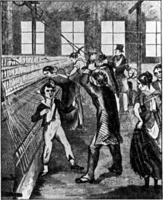
Industrialization and Immigration
Reading Level
     edHelper's suggested reading level:   grades 6 to 8
     Flesch-Kincaid grade level:   7.27

Vocabulary
     challenging words:    persecution, starvation, riches, homeland, better, industry, political, economy, production, mass, poverty, between, goods, lower, based, factory
     content words:    United States, Civil War


Print Industrialization and Immigration
edHelper.com subscriber options:
     Print Industrialization and Immigration  (font options, pick words for additional puzzles, and more)

     Quickly print reading comprehension

     Print a proofreading activity


Feedback on Industrialization and Immigration
     Leave your feedback on Industrialization and Immigration  (use this link if you found an error in the story)


Industrialization and Immigration
By Cindy Grigg
  

1     In the hundred years between 1820 and 1920, more than thirty million immigrants came to America. The countries who sent the most immigrants were Germany and Ireland, but immigrants came from all over Europe. They left their homeland because of poverty, starvation, and religious and political persecution. Many of them were so poor that they were evicted from their homes. They had nowhere else to go.
 
2     They heard stories of others who had come to America and found freedom, quick riches, and easy lives. These stories were not true, but hope fueled the immigrants' strong desire to find a better life for themselves and their children. But as harsh as their lives in their homelands might have been, it was not an easy decision to leave everything behind. They knew the journey would be long and difficult.
 
3     The immigrants who poured by the thousands into American cities in the last decades of the 1800s arrived at a time of great change in America. The United States had always been a country of farms and small towns. All that changed after the end of the Civil War in 1865. The United States' economy changed from an economy based on manual labor to one based on machine industry. Sewing machines were invented that made the mass production of clothing much faster and cheaper. Cotton mills used the steam engine to make the process of making raw cotton into cotton cloth more efficient. More and more people moved to the cities. The cities offered a large variety of goods and services that had never been available in small towns. The cities also offered jobs.

Paragraphs 4 to 7:
For the complete story with questions: click here for printable


Copyright © 2008 edHelper