edHelper.com
Weather


Using Technology to Study Lightning


Using Technology to Study Lightning
Reading Level
     edHelper's suggested reading level:   grades 6 to 8
     Flesch-Kincaid grade level:   8.57

Vocabulary
     challenging words:    redirect, occurrence, atmospheric, utility, reading, bolts, pads, armed, fairly, bolt, pathway, highly, naturally, launch, trigger, natural
     content words:    United States, Mother Nature, Benjamin Franklin, Electric Power Research Institute


Print Using Technology to Study Lightning
edHelper.com subscriber options:
     Print Using Technology to Study Lightning  (font options, pick words for additional puzzles, and more)

     Quickly print reading comprehension

     Print a proofreading activity


Feedback on Using Technology to Study Lightning
     Leave your feedback on Using Technology to Study Lightning  (use this link if you found an error in the story)


Using Technology to Study Lightning
By Cindy Grigg
  

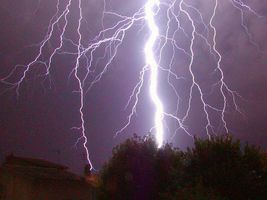
1     By the time you finish reading this sentence, lightning will have flashed more than five hundred times around the world. This common occurrence can have dangerous results. Each year in the United States alone, lightning kills almost one hundred people. It also causes several hundred million dollars in damage.
 
2     A bolt of lightning can travel at a speed of 136,000 miles per hour (220,000 km/h). It can reach temperatures of 54,000 degrees Fahrenheit (30,000 degrees Celsius), which is hot enough to melt sand into glass. Lightning heats nearby air to about 18,000 degrees Fahrenheit (10,000 degrees Celsius) nearly instantly, which is almost twice the temperature of the sun's surface. The heating creates a shock wave that is heard as thunder.
 
3     Even though controlling this awesome outburst of Mother Nature may seem impossible, scientists around the world are searching for ways to do just that. Scientists have learned many things about lightning in the more than 250 years since Benjamin Franklin did his kite experiment. Natural lightning is very difficult to study. Scientists must know where it is going to strike and have their instruments at that point and ready ahead of time. So today when scientists want to study lightning, they stand in a carefully insulated trailer. Then they launch a rocket toward a thundercloud to create an artificial lightning bolt.

Paragraphs 4 to 10:
For the complete story with questions: click here for printable


Copyright © 2008 edHelper