edHelper.com
Solar System


Could There Be Water on the Moon?


Could There Be Water on the Moon?
Reading Level
     edHelper's suggested reading level:   grades 6 to 8
     Flesch-Kincaid grade level:   8.05

Vocabulary
     challenging words:    refueling, further, topography, neutron, striking, factor, representation, spacecraft, shadowy, billion, presence, crater, valuable, itself, mass, vast
     content words:    South Pole-Aitken Basin, Image Credit, Clementine Science Group, Planetary Institute, Lunar Prospector, Aitken Basin


Print Could There Be Water on the Moon?
edHelper.com subscriber options:
     Print Could There Be Water on the Moon?  (font options, pick words for additional puzzles, and more)

     Quickly print reading comprehension

     Print a proofreading activity


Feedback on Could There Be Water on the Moon?
     Leave your feedback on Could There Be Water on the Moon?  (use this link if you found an error in the story)


Could There Be Water on the Moon?
By Cindy Grigg
  

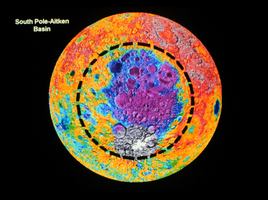
1     Caption: This image - taken by NASA's Clementine spacecraft - consists of color-coded topography overlaid on a shaded relief representation of the Moon. Purples and blues are low, and orange and reds are high. The South Pole-Aitken Basin is the biggest, deepest impact basin in the solar system. The rim crest is about 2500 kilometers in diameter, and the basin is up to 13 kilometers in depth in some places. Its average depth is about 10 kilometers. Image Credit: Clementine Science Group, Lunar and Planetary Institute
 
2     The first American astronauts landed on the moon on July 20, 1969. Several other missions after that explored the moon's surface. Astronauts even brought moon rocks back to Earth to study them. None of the many samples of moon rocks contained any trace of water. Because the astronauts didn't see any water on the moon and scientists didn't detect any in the lab, no one believed there could be any water on the moon.
 
3     Then in 1994, an American spacecraft called Clementine beamed radio waves toward different areas of the moon. Some of the areas included a few craters that never receive any sunlight. Mostly the radio waves were reflected back by what appeared to be ground-up rock. But in one part of a huge dark crater, the radio waves were reflected back as if by ice!

Paragraphs 4 to 6:
For the complete story with questions: click here for printable


Copyright © 2008 edHelper