edHelper.com
Polar Bears and Global Warming


Polar Bears and Global Warming
Reading Level
     edHelper's suggested reading level:   grades 4 to 6
     Flesch-Kincaid grade level:   5.38

Vocabulary
     challenging words:    dependent, extinction, phenomenal, scientific, entire, fully, seabirds, warmth, region, dioxide, ecosystem, ringed, predator, general, remain, travels
     content words:    Western Hudson Bay


Print Polar Bears and Global Warming
     Print Polar Bears and Global Warming  (font options, pick words for additional puzzles, and more)


Quickly Print - PDF format
     Quickly Print: PDF (2 columns per page)

     Quickly Print: PDF (full page)


Quickly Print - HTML format
     Quickly Print: HTML


Proofreading Activity
     Print a proofreading activity


Feedback on Polar Bears and Global Warming
     Leave your feedback on Polar Bears and Global Warming  (use this link if you found an error in the story)


Polar Bears and Global Warming
By Jennifer Kenny
  

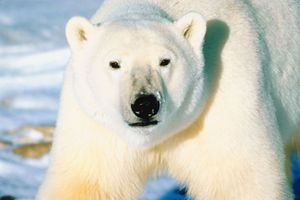
1     Polar bears have a scientific name. It is Ursus maritimus. That's Latin for sea bear. Some cultures refer to polar bears as the great white bear, ice bear, or nanook. Polar bears are the largest kind of bear on Earth. They live in the Arctic. They are used to winters where temperatures dip to 22 below zero Fahrenheit and summers reach no higher than 50 degrees.
 
2     Polar bears spend most of their time around water. Zook is one such polar bear. He hunts, travels, and mates on the sea ice. He is a phenomenal swimmer. He has a coat that conserves heat. He has a layer of fat for warmth. Zook weighs 1,000 pounds. In general, fully grown males weigh between 880 and 1300 pounds. Fully grown females are approximately half that size. They have sharp, jagged teeth. They like to swallow their prey in large chunks. They have enormous paws that act like snowshoes on the ice.
 
3     Polar bears are the largest predator in the Arctic water ecosystem. They need to eat around four pounds of fat a day. They primarily hunt ringed seals. They like to catch seals by waiting for them by their breathing holes even if they have to stay still for hours. When they can't find ringed seals, they will hunt bearded seals, harp seals, walruses, beluga whales, and seabirds. They eat the most from late April to mid July. When the ice is gone, which is supposed to be only three to four months, polar bears usually fast. Some, though, move north in the summer to hunt.

Paragraphs 4 to 8:
For the complete story with questions: click here for printable


Extended Activities:

1.  Research ways to slow global warming

2.  Find out what other animals might be affected by global warming. Create a poster to save one animal.


Copyright © 2009 edHelper