edHelper.com
History of Mathematics


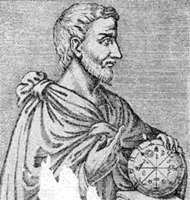
Pythagoras: the Father of Numbers


Pythagoras: the Father of Numbers
Reading Level
     edHelper's suggested reading level:   grades 6 to 7
     Flesch-Kincaid grade level:   7.4

Vocabulary
     challenging words:    semicircle, parchment, philosophical, ponder, society, fairly, philosopher, universe, religion, philosophy, founded, mathematics, prisoner, prove, political, listeners
     content words:    Pythagorean Theorem


Print Pythagoras: the Father of Numbers
edHelper.com subscriber options:
     Print Pythagoras: the Father of Numbers  (font options, pick words for additional puzzles, and more)

     Quickly print reading comprehension

     Print a proofreading activity


Feedback on Pythagoras: the Father of Numbers
     Leave your feedback on Pythagoras: the Father of Numbers  (use this link if you found an error in the story)


Pythagoras: the Father of Numbers
By Mary Lynn Bushong
  

1     Why is it hard to learn about people who lived a long time ago? Records were difficult to preserve. Clay tablets were easily broken, while papyrus, paper, and parchment could be destroyed any number of ways.
 
2     While many facts about Pythagoras are not certain, some are fairly well established. He was born between 580 and 572 BC on the Greek island of Samos. His mother, Pythais, was a native of Samos, while his father, Mnesarchus, was a Phoenician merchant.
 
3     It is thought that Pythagoras traveled widely with his father. Some stories about Pythagoras have him staying in Tyre, his father's home city.
 
4     As a child and young man, he was taught music and played the lyre well. He was also taught poetry, philosophy, and math. Three of the philosopher tutors who had a great influence on his own ideas were Pherekydes, Thales, and Anaximander.
 
5     Through those three men, Pythagoras became interested in cosmology and mathematics. Later he was encouraged to travel to Egypt to build on his knowledge. There they had perfected the use of geometry.

Paragraphs 6 to 15:
For the complete story with questions: click here for printable


Copyright © 2008 edHelper