edHelper.com
The 2000's
Mexico's Rainforest


Mexico's Rainforest
Reading Level
     edHelper's suggested reading level:   grades 5 to 8
     Flesch-Kincaid grade level:   7.93

Vocabulary
     challenging words:    mid-twentieth, controversy, aerial, provides, dioxide, provided, erosion, illegal, cutting, mahogany, carbon, understory, canopy, account, better, opposition
     content words:    Lacandon Rainforest Region, Montes Azules Biosphere Reserve


Print Mexico's Rainforest
     Print Mexico's Rainforest  (font options, pick words for additional puzzles, and more)


Quickly Print - PDF format
     Quickly Print: PDF (2 columns per page)

     Quickly Print: PDF (full page)


Quickly Print - HTML format
     Quickly Print: HTML


Proofreading Activity
     Print a proofreading activity


Feedback on Mexico's Rainforest
     Leave your feedback on Mexico's Rainforest  (use this link if you found an error in the story)


Mexico's Rainforest
By Sharon Fabian
  

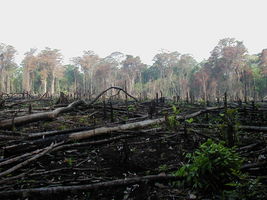
1     Aerial photographs left no room for doubt. Year after year, they clearly showed that the rainforests were shrinking.
 
2     Conservationists worked hard to stop the loss of rainforests. They had important reasons for protecting the rainforests. Rainforests help to keep our earth healthy. They help to regulate the temperature of the earth, and they fight pollution. Rainforest plants absorb carbon dioxide, and they produce clean air. They also provide foods and medicines.
 
3     Even with all of these good reasons, the conservationists met opposition.
 
4     People living in and around the rainforests had important reasons of their own for cutting down rainforest trees. Rainforests were an important source of income. Rainforest trees were a valuable source of lumber, and rainforest trees could be cleared to make way for farm land.
 
5     The Lacandon Rainforest Region in Mexico provides a good example of how a rainforest can become a source of controversy. Events there showed what a complicated situation saving a rainforest can become.

Paragraphs 6 to 14:
For the complete story with questions: click here for printable


Copyright © 2009 edHelper