edHelper.com
Life Science
Animal and Biomes Basics Theme Unit
Kingdom: Monera (Archaebacteria and Eubacteria)


Kingdom: Monera (Archaebacteria and Eubacteria)
Reading Level
     edHelper's suggested reading level:   grades 6 to 8
     Flesch-Kincaid grade level:   9.17

Vocabulary
     challenging words:    prokaryotes, sewage, nucleus, acidic, modern-day, thermal, atmosphere, chlorophyll, membrane, extremely, boiling, blue-green, spiral, extreme, contribute, interior
     content words:    Pacific Ocean, Yellowstone National Park


Print Kingdom: Monera (Archaebacteria and Eubacteria)
     Print Kingdom: Monera (Archaebacteria and Eubacteria)  (font options, pick words for additional puzzles, and more)


Quickly Print - PDF format
     Quickly Print: PDF (2 columns per page)

     Quickly Print: PDF (full page)


Quickly Print - HTML format
     Quickly Print: HTML


Proofreading Activity
     Print a proofreading activity


Feedback on Kingdom: Monera (Archaebacteria and Eubacteria)
     Leave your feedback on Kingdom: Monera (Archaebacteria and Eubacteria)  (use this link if you found an error in the story)


Kingdom: Monera (Archaebacteria and Eubacteria)
By Cindy Grigg
  

1     When Linnaeus began classifying living things, he used only two kingdoms, plant and animal. With the technology of microscopes, new living things were discovered. Differences could be seen inside their cells. Two kingdoms were not enough. Most scientists today use either a five-kingdom or six-kingdom classification system.
 
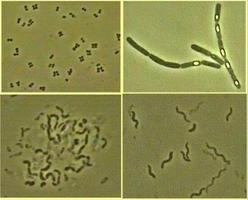
2     Until recently, all bacteria were grouped together in one kingdom (five kingdom system). This was because their cell structure was similar. The five-kingdom system is divided into animal, plant, fungi, protist, and monera. The monera kingdom is made up of two groups called phyla. Both of these phyla are made up of one-celled organisms, which are all bacteria. None of them have a true nucleus. One-celled (unicellular) organisms whose DNA is not contained inside a nucleus are called prokaryotes (PRO care ee oats). They are bacteria. Bacteria mostly absorb their food. Some have chlorophyll. These bacteria can be round, rod-shaped, or spiral shaped. The other phylum is the cyanobacteria. They are often called blue-green bacteria. They can make their own food using chlorophyll and are mostly blue-green in color.
 
3     More recently, a six-kingdom classification system has been used. The six divisions are animal, plant, fungi, protist, eubacteria, and archaebacteria. The last two divisions are used based on the type of cells the organism has, whether or not it can make its own food, and the number of cells in each organism. Because some bacteria are chemically different, the monera kingdom was separated into the two new kingdoms.

Paragraphs 4 to 6:
For the complete story with questions: click here for printable


Copyright © 2009 edHelper