edHelper.com
How Stethoscopes Work


How Stethoscopes Work
Reading Level
     edHelper's suggested reading level:   grades 3 to 6
     Flesch-Kincaid grade level:   4.03

Vocabulary
     challenging words:    heartbeat, lightweight, directly, fluid, uncomfortable, clearly, irregular, signal, onto, ever, against, often, sounds, since, comfortable, breathe


Print How Stethoscopes Work
     Print How Stethoscopes Work  (font options, pick words for additional puzzles, and more)


Quickly Print - PDF format
     Quickly Print: PDF (2 columns per page)

     Quickly Print: PDF (full page)


Quickly Print - HTML format
     Quickly Print: HTML


Proofreading Activity
     Print a proofreading activity


Feedback on How Stethoscopes Work
     Leave your feedback on How Stethoscopes Work  (use this link if you found an error in the story)


How Stethoscopes Work
By Brandi Waters
  

1     If you have ever been to see a doctor, you have seen a stethoscope. Doctors often wear them around their necks. They use the stethoscope to listen to sounds inside your body. Most doctors use them to listen to your heart or lungs. They can be used to listen to sounds all over the body. Doctors place one end of the stethoscope on your back or chest. They place the other end into their ears. The stethoscope makes it easy to hear the sounds inside your body.
 
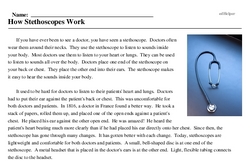
2     It used to be hard for doctors to listen to their patients' heart and lungs. Doctors had to put their ear against the patient's back or chest. This was uncomfortable for both doctors and patients. In 1816, a doctor in France found a better way. He took a stack of papers, rolled them up, and placed one of the open ends against a patient's chest. He placed his ear against the other open end. He was amazed! He heard the patient's heart beating much more clearly than if he had placed his ear directly onto her chest. Since then, the stethoscope has gone through many changes. It has gotten better with each change. Today, stethoscopes are lightweight and comfortable for both doctors and patients. A small, bell-shaped disc is at one end of the stethoscope. A metal headset that is placed in the doctor's ears is at the other end. Light, flexible tubing connects the disc to the headset.

Paragraphs 3 to 4:
For the complete story with questions: click here for printable


Copyright © 2009 edHelper