edHelper.com
How Does a Venus Flytrap Trap Flies?


How Does a Venus Flytrap Trap Flies?
Reading Level
     edHelper's suggested reading level:   grades 6 to 8
     Flesch-Kincaid grade level:   7.24

Vocabulary
     challenging words:    flytrap, sundew, sundews, nutritious, adaptation, trapping, built-in, lobe, digestion, spits, airtight, supplement, digestive, carnivorous, itself, soil


Print How Does a Venus Flytrap Trap Flies?
     Print How Does a Venus Flytrap Trap Flies?  (font options, pick words for additional puzzles, and more)


Quickly Print - PDF format
     Quickly Print: PDF (2 columns per page)

     Quickly Print: PDF (full page)


Quickly Print - HTML format
     Quickly Print: HTML


Proofreading Activity
     Print a proofreading activity


Feedback on How Does a Venus Flytrap Trap Flies?
     Leave your feedback on How Does a Venus Flytrap Trap Flies?  (use this link if you found an error in the story)


How Does a Venus Flytrap Trap Flies?
By Sharon Fabian
  

1     Plants get their nutrients from the soil. They get energy from the sun, and photosynthesis takes care of everything. But some unlucky little plants live where the soil just isn't nutritious enough. What do they do?
 
2     One of those plants is the Venus flytrap, and when it needs more nutrients, it just traps itself some meat and has a hearty meal like all of us carnivores in the animal world do. Most plants can't do that, but a few really can. Venus flytraps are one of the plants capable of moving quickly to trap food. Sundews and waterwheel plants also have this unusual ability. It is an adaptation to the environments in which they live. Their environments have soil that is unusually low in nutrients, and so the plants supplement their diet by trapping insects.
 
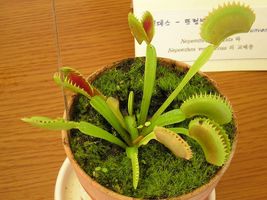
3     Venus flytraps have built-in traps. The have two-sectioned leaves that are hinged in the middle so that they can snap shut. On each of the two lobes, there are tiny hairs called cilia that bend when an insect lands there. This movement allows the Venus flytrap to sense when an insect lands there. Around the edges of each lobe there are stiff spikes that mesh together to hold the insects in whenever the trap snaps shut.

Paragraphs 4 to 10:
For the complete story with questions: click here for printable


Copyright © 2009 edHelper