edHelper.com
Hoary Marmots


Hoary Marmots

A Short Reader

Reading Level
     edHelper's suggested reading level:   grades 4 to 6
     Flesch-Kincaid grade level:   3.76

Vocabulary
     challenging words:    sunbathe, hoary, marmot, northwestern, lower, upper, roots, large, natural, danger, several, kinds, layer, hibernate, warn, body
     content words:    North America


Print Hoary Marmots
     Print Hoary Marmots  (font options, pick words for additional puzzles, and more)


Quickly Print - PDF format
     Quickly Print: PDF (2 columns per page)

     Quickly Print: PDF (full page)


Quickly Print - HTML format
     Quickly Print: HTML


Proofreading Activity
     Print a proofreading activity


Feedback on Hoary Marmots
     Leave your feedback on Hoary Marmots  (use this link if you found an error in the story)


Hoary Marmots
By Sheri Skelton
  

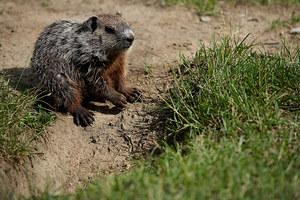
1     Hoary marmots are very large rodents. They live on grassy slopes in the mountains in northwestern North America. Hoary marmots like to sunbathe on the rocks. The rocks are also good lookout spots to see enemies or to hide from enemies. Wolves, coyotes, foxes, and lynxes like to eat hoary marmots. Golden eagles find hoary marmots very tasty.
 
2     Hoary marmots are sometimes called "whistle pigs." They warn others when danger is near by whistling very loudly. Their whistles can be heard a mile away. Hoary marmots live in little colonies, or neighborhoods. They look out for each other. They live in burrows. Their burrows have several exits. They line their nests in the burrows with grass and hair. This makes the burrows cozy and warm. Hoary marmots may hibernate for as long as eight months.
 
3     Hoary marmots curl up in little balls to hibernate. Before they hibernate, they eat lots of food. They store the food in their bodies in an extra layer of fat. This is a special kind of fat known as "brown fat." Hoary marmots are herbivores. They eat plants. They eat different kinds of grasses, roots, berries, and seeds.

Paragraphs 4 to 5:
For the complete story with questions: click here for printable


Copyright © 2009 edHelper