edHelper.com
The Civil War
(1861-1865)

Naval Warfare


Naval Warfare
Reading Level
     edHelper's suggested reading level:   high interest, readability grades 4 to 6
     Flesch-Kincaid grade level:   5.67

Vocabulary
     challenging words:    despite, successful, participant, naval, renamed, entire, aground, scuttled, hull, effective, warship, victory, also, ports, waterway, opposite
     content words:    CSS Virginia, Confederate States Navy, American Civil War, USS Merrimack, Hampton Roads, USS Monitor, Civil War, In March, North Carolina


Print Naval Warfare
     Print Naval Warfare  (font options, pick words for additional puzzles, and more)


Quickly Print - PDF format
     Quickly Print: PDF (2 columns per page)

     Quickly Print: PDF (full page)


Quickly Print - HTML format
     Quickly Print: HTML


Proofreading Activity
     Print a proofreading activity


Feedback on Naval Warfare
     Leave your feedback on Naval Warfare  (use this link if you found an error in the story)


Naval Warfare
By Cathy Pearl
  

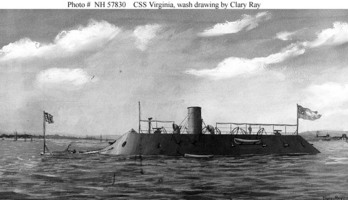
1     Caption: CSS Virginia also known as the Merrimack was an ironclad warship of the Confederate States Navy during the American Civil War (built using the remains of the scuttled USS Merrimack ). Participant in the Battle of Hampton Roads in March 1862 opposite the USS Monitor - the first battle between two powered ironclad warships
 
2     The Civil War was not only fought on land. There were also some battles at sea. Early in the war, the Union used its ships to block ports in the South. This is called a blockade. At first, small Southern ships could sneak through the blockade and bring goods back to the South. As the war went on, the Union blockade became more effective. Trade to the South was almost completely stopped.
 
3     The South needed a way to break the blockade. One thing that they tried was the ironclad ship. The U.S.S. Merrimack had been a Union ship. It was in Virginia when that state seceded. To keep the Confederates from using it, the ship was burned.
 
4     The Confederates salvaged the ship and rebuilt it. Instead of using only wood, the sides of the ship were covered with iron plates. The Confederates renamed it the Virginia. Today, most historians refer to it by its earlier name.
 
5     The ship's hull was covered in tons of steel. Even though the ship weighed a lot, it was faster than it looked. In March of 1862, the ship attacked the blockade. It was successful in the beginning. Several ships were destroyed and others were run aground. Unfortunately, the North had learned about the South's weapon. The North had also built an ironclad called the Monitor. The ship arrived the next day. The two ships met in battle in the waters near Virginia.

Paragraphs 6 to 14:
For the complete story with questions: click here for printable


Copyright © 2009 edHelper