edHelper.com
Solar System


The Rocky Planets


The Rocky Planets
Reading Level
     edHelper's suggested reading level:   high interest, readability grades 5 to 7
     Flesch-Kincaid grade level:   5.12

Vocabulary
     challenging words:    radius, tectonic, trapping, orbit, atmosphere, solar, system, provides, outer, totally, daytime, rotation, opposite, core, mass, nighttime
     content words:    But Venus


Print The Rocky Planets
edHelper.com subscriber options:
     Print The Rocky Planets  (font options, pick words for additional puzzles, and more)

     Quickly print reading comprehension

     Print a proofreading activity


Feedback on The Rocky Planets
     Leave your feedback on The Rocky Planets  (use this link if you found an error in the story)


The Rocky Planets
By Patti Hutchison
  

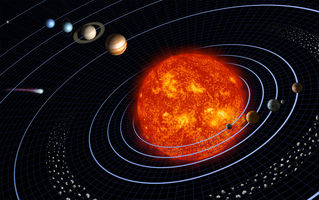
1     Our solar system is made up of mostly empty space. It contains the sun, the planets and their moons, and other bodies such as comets and asteroids. But each of these is much smaller than the space between them. Scientists believe there are other bodies "out there" that have not been discovered yet.
 
2     Planets are divided into two categories. There are the "rocky" planets and the "gas giant" planets. Rocky planets include Mercury, Venus, Earth, and Mars.
 
3     Mercury is the closest planet to the sun. It is difficult to see from Earth. Mercury is about one-third the size of Earth. It completes a trip around the sun every 88 (Earth) days. This makes it the fastest orbiting planet, moving at about 50 kilometers per second.
 
4     Mercury spins slowly on its axis, however. In two of its years (orbits) only three days pass! The length of one Mercury day is equal to about 58 Earth days.
 
5     The daytime temperature on Mercury can reach over 425 degrees Celsius. There is very little atmosphere to absorb this heat, however. The nighttime temperature goes down to about -170 degrees. This is the largest temperature difference of all the planets in our solar system.
 
6     The surface of Mercury looks almost like our Moon's surface. There are many craters caused by collisions with meteoroids and comets. There are some areas of smooth surface. In some places there are tall, sharp cliffs. Mercury's iron core has a radius of about 1800 kilometers. It is surrounded by an outer shell that is only about 500 kilometers thick.
 
7     Next in line is Venus. Venus is very similar to Earth. The two planets have about the same size and mass. But Venus does not look blue, as Earth does. Venus has no ocean. It is covered with a thick mass of clouds. The clouds spin very fast, trapping surface heat. This makes the surface temperatures very hot and the surface pressure very high.
 
8     Venus revolves around the sun once every 225 (Earth) days. It takes 243 Earth days for it to make one rotation on its axis. Venus spins in the opposite direction, compared to Earth. If you lived on Venus, the sun would appear to rise in the west and set in the east!
 
9     The surface of Venus is highly eroded. It also has large volcanic ridges. It has an iron core that is about 3000 kilometers in diameter. Scientists think this core might be liquid and extends halfway to the surface of Venus.

Paragraphs 10 to 17:
For the complete story with questions: click here for printable


Copyright © 2008 edHelper